
General
Preferred name
Peimisine
Synonyms
Ebeiensine ()
Peimisine (hydrochloride) ()
P&D ID
PD100449
CAS
139893-27-9
19773-24-1
900498-44-4
Tags
available

Probe control
Probe control not defined

Orthogonal probes
0
No orthogonal probes found

Similar probes
0
No structurally similar probes found
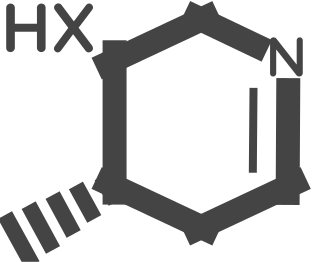 Structure

 P&D probe-likeness score

Structure formats
[[ format ]]
[[ compound[format === 'MOL' ? 'molblock' : format.toLowerCase()] ]]
Description
(extracted from source data)
DESCRIPTION
Peimisine (Ebeiensine) is a muscarinic M receptor antagonist and angiotensin converting enzyme (ACE) inhibitor. Peimisine shows anti-tumor, anti-inflammatory, antihypertensive activities. Peimisine can induce apoptosis and be used in cough and asthma research[1][2][3].
PRICE
108
DESCRIPTION
1. Peimisine (Ebeiensine) can affect M-receptor, excit ??-receptor, restrain the release of internal calcium, and promote to releaseing nitrogen monoxidum in order to relax tracheal smooth muscle and relieve asthma. 2. Peimisine can attenuate lung tissue injury( ALI), LDH and MDA amount in ALI mice in a dose dependent manner, it also lower the total protein, total white blood cells, lymphocyte and neutrophilic leukocyte in bronchoalveolar lavage fluid( BALF); suggests that peimisine can play a protective role against LPS-induced acute lung injury. 3. Peimisine has the protective effect on the experimental hepatic fibrosis formation, the possible mechanisms are associated with inhibiting fibrogenesis and fibrosis accumulation, and decreasing lipid peroxidation. 4. Peimisine can inhibit angiotensin I converting enzyme activity in a dose-dependent manner, displaying 5 % inhibitory concentration values of 526.5 microM, thus, it may have antihypertensive action.
DESCRIPTION
1. Peimisine (Ebeiensine) can affect M-receptor, excit β-receptor, restrain the release of internal calcium, and promote to releaseing nitrogen monoxidum in order to relax tracheal smooth muscle and relieve asthma. 2. Peimisine can attenuate lung tissue injury( ALI), LDH and MDA amount in ALI mice in a dose dependent manner, it also lower the total protein, total white blood cells, lymphocyte and neutrophilic leukocyte in bronchoalveolar lavage fluid( BALF); suggests that peimisine can play a protective role against LPS-induced acute lung injury. 3. Peimisine has the protective effect on the experimental hepatic fibrosis formation, the possible mechanisms are associated with inhibiting fibrogenesis and fibrosis accumulation, and decreasing lipid peroxidation. 4. Peimisine can inhibit angiotensin I converting enzyme activity in a dose-dependent manner, displaying 5 % inhibitory concentration values of 526.5 microM, thus, it may have antihypertensive action.
(TargetMol Bioactive Compound Library)
[[ p.pathway_name ]]
[[ compound.targets[tid].gene_name ]]

Compound Sets
4
[[ a.name ]]
[[ ligand_id ]]
free of charge
External IDs
19

Molecular Weight
427.31
Hydrogen Bond Acceptors
4
Hydrogen Bond Donors
2
Rotatable Bonds
0
Ring Count
6
Aromatic Ring Count
0
cLogP
4.26
TPSA
58.56
Fraction CSP3
0.89
Chiral centers
11.0
Largest ring
6.0
QED
0.57

Structural alerts
0
No structural alerts detected

Related compounds
Custom attributes
(extracted from source data)
Pathway
Endocrinology/Hormones
Neuroscience
GPCR/G protein
Metabolic Enzyme/Protease
Neuronal Signaling
Target
Angiotensin-converting Enzyme (ACE)
Apoptosis
mAChR
M2 Muscarinic Receptors, Angiotensin-Converting Enzyme (ACE), Nav1.7 Channels, Kv1.2 Channels, Kv1.3 Channels, hERG Channels
angiotensin I converting enzyme (ACE1)
Source data