
General
Preferred name
Menadiol diphosphate
Synonyms
Vitamin K 4 ()
Kapilon ()
Synkayvite ()
Menadiol ()
Kappadione ()
Kappaxan ()
menadiol sodium diphosphate ()
MENADIOL DIPHOSPHORIC ACID ()
Thylokay ()
Synka-vit ()
Caidrine ()
Procoagulo ()
Synkavite ()
Kativ ()
Menadiol sodium phosphate ()
P&D ID
PD073859
CAS
84-98-0
131-13-5
6700-42-1
Tags
available
drug
Approved by
FDA
Drug indication
Coagulation defect
Drug Status
approved
nutraceutical
Max Phase
4.0
First approval
1982

Probe control
Probe control not defined

Orthogonal probes
0
No orthogonal probes found

Similar probes
0
No structurally similar probes found
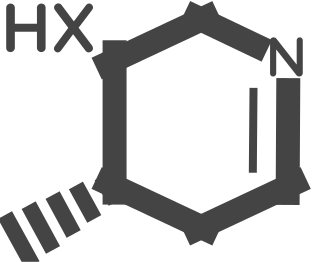 Structure

 P&D probe-likeness score

Structure formats
[[ format ]]
[[ compound[format === 'MOL' ? 'molblock' : format.toLowerCase()] ]]
Description
(extracted from source data)
ABSORPTION
Menadiol sodium phosphate (vitamin K3), the synthetic analog of vitamin K, being water soluble, is advised in intestinal malabsorption or in states in which bile flow is deficient. The primary disadvantage is that it takes 24 h to initiate therapeutic effects, however, this effect lasts for several days. The dose is 5â40 mg orally, daily. Menadiol sodium phosphate, even in moderate doses, may lead to hemolytic anemia and, for this reason, neonates should not receive this medication. This precautionary measure is valid especially those that are deficient in glucose 6-phosphate dehydrogenase (G6PD); their immature livers are unable to compensate for the heavy bilirubin load and there is an increased risk of kernicterus [L1563].; ;
INDICATION
Anticoagulant-induced prothrombin deficiency caused by coumadin or indanedione derivatives,; prophylaxis and therapy of hemorrhagic disease of the newborn, hypoprothrombinemia due to antibacterial therapy,; hypoprothrombinemia secondary to factors limiting absorption or synthesis of vitamin K (for example, obstructive jaundice, biliary fistula, sprue, ulcerative colitis, celiac disease, intestinal resection, cystic fibrosis of the pancreas, and regional enteritis, other drug-induced hypoprothrombinemia where it is definitely shown that the result is due to interference with vitamin K metabolism) [L1545, L1546].
ROE
Vitamin K is heavily metabolized in the liver and excreted in the urine and bile. In tracer studies, it was found that approximately 20% of an injected dose of phylloquinone (Vitamin K metabolite) was found in the urine whereas about 40-50 % was excreted in the feces via the biliary system. The proportion of drug excreted was the same regardless of whether the injected dose was 1 mg or 45 µg. It can, therefore, be inferred that about 60-70% percent of the amounts of phylloquinone absorbed from each vitamin-K containing meal will be lost to the body by excretion [L1570].; ; Two major human excretion products have been identified: carboxylic acids with 5 and 7-carbon sidechains that are excreted in the urine as glucuronide conjugates. The biliary metabolites have not been clearly identified but are initially excreted as water-soluble conjugates and become lipid soluble during their passage through the gut, probably through deconjugation by the gut flora. There is no evidence for body stores of vitamin K being conserved by an enterohepatic circulation. Vitamin K itself is too lipophilic to be excreted in the bile and the sidechain-shortened carboxylic acid metabolites are not biologically active [L1570].;
METABOLISM
Menadione or 2-methyl-1,4-naphthoquinone is a synthetic vitamin K analog, undergoes 1-electron reduction by enzymes such as microsomal NADPHâcytochrome P450 reductase and mitochondrial NADHâubiquinone oxidoreductase (complex I), resulting in redox cycling, or it detoxification via two-electron reduction by NAD(P)Hâquinone oxidoreductase [A32072].; ; Vitamin K is a group of lipophilic, hydrophobic vitamins that exist naturally in two forms (and in 3 synthetic forms): vitamin K1, which is found in plants, and vitamin K2, which is synthesized by bacteria. Vitamin K is an important dietary component because it is necessary as a cofactor in the activation of vitamin K dependent proteins. Metabolism of vitamin K occurs mainly in the liver. In the first step, vitamin K is reduced to its quinone form by a quinone reductase such as NADPH dehydrogenase. Reduced vitamin K is the form required to convert vitamin K dependent protein precursors to their active states. It acts as a cofactor to the integral membrane enzyme vitamin K-dependent gamma-carboxylase (along with water and carbon dioxide as co-substrates), which carboxylates glutamyl residues to gamma-carboxy-glutamic acid residues on certain proteins, activating them. Each converted glutamyl residue produces a molecule of vitamin K epoxide, and certain proteins may have more than one residue requiring carboxylation. To end the cycle, the vitamin K epoxide is returned to vitamin K via the vitamin K epoxide reductase enzyme, also an integral membrane protein. The vitamin K dependent proteins include various important coagulation factors, such as prothrombin. Warfarin and other coumarin drugs act as anticoagulants by blocking vitamin K epoxide reductase [L1568].;
[[ p.pathway_name ]]
[[ compound.targets[tid].gene_name ]]
Compound Sets
10
ChEMBL Approved Drugs
ChEMBL Drugs
DrugCentral
DrugCentral Approved Drugs
DrugMAP
DrugMAP Approved Drugs
Other bioactive compounds
ReFrame library
[[ a.name ]]
[[ ligand_id ]]
free of charge
External IDs
42

Molecular Weight
334.0
Hydrogen Bond Acceptors
4
Hydrogen Bond Donors
4
Rotatable Bonds
4
Ring Count
2
Aromatic Ring Count
2
cLogP
2.09
TPSA
133.52
Fraction CSP3
0.09
Chiral centers
0.0
Largest ring
6.0
QED
0.62

Structural alerts
0
No structural alerts detected

Related compounds
Custom attributes
(extracted from source data)
Source data