
General
Preferred name
Gadobutrol
Synonyms
P&D ID
PD059156
Tags
drug
contains metal
Drug Status
approved

Probe control
Probe control not defined

Orthogonal probes
0
No orthogonal probes found

Similar probes
0
No structurally similar probes found
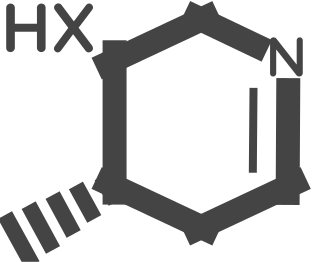 Structure

 P&D probe-likeness score

Structure formats
[[ format ]]
[[ compound[format === 'MOL' ? 'molblock' : format.toLowerCase()] ]]
Description
(extracted from source data)
PHARMACODYNAMICS
Even at low concentrations Gadobutrol can lead to distinct shortening of relaxation times of protons in plasma. At physiological conditions (pH=7, temperature=37°C), and 1.5T, the relaxivity (r1) is 5.2L/(mmol·sec) based on the relaxation times (T1), while the relativity (r2) is 6.1L/(mmol·sec) based on relaxation times (T2). ; ; Magnetic field strength has only slight influence on relaxivities. ; ; Drug concentration and r1 relaxivity may contribute to a T1 shortening effect, which may improve tissue visualization.
MOA
MRI tissue visualization is dependent, in part, on variations in intensity of radiofrequency signals which occur due to differences in proton density, differences of the spin-lattice or longitudinal relaxation times (T1), and differences in the spin-spin or transverse relaxation times (T2).; ; Gadolinium shortens T1 and T2 relaxation times. Greater signal enhancement is achieved with increased shortening of T1 and T2. The extent to which Gadolinium can shorten T1 and T2 is influenced by concentration in tissue, MRI field strength, and the relative ratio of transverse and longitudinal relaxation times. ; ; The recommended dose produced the greatest sensitivity of T1 shortening effect in T1-weighted magnetic resonance sequences. ; In T2-weighted sequences, the large magnetic moment of gadolinium induced local magnetic field inhomogenenities. ; ; At high concentrations used during bolus injections, T2-weighted sequences show a signal decrease.
ROE
Excreted unchanged via glomerular filtration by the kidneys. ; Extrarenal elimination is negligible.
TOXICITY
Lethality was observed in rodents after a single intravenous administration of 20 mmol/kg. This represents a dose of at least 2 orders of magnitude; higher than the standard single diagnostic dose in humans (0.1 mmol/kg).; ; No carcinogenicity studies have been conducted. ; ; No mutagenesis was observed in vitro in reverse mutation tests in bacteria, or in the HGPRT (hypoxanthine-guanine phosphoribosyl transferase) test using Chinese hamster V79 cells. Similarly, no mutagenesis was seen in chromosome abberation tests of human peripheral blood lymphocytes. It was also negative in in-vivo micronucleus tests in mice following a 0.5mmol/kg intravenous injection. ; ; No fertility or reproductive impairment was observed in male and female rates given doses 12.2 times human equivalent doses, based on body surface area. ; ; Intolerance reactions local to the injection site have been observed in rabbits after paravenous administration, and are associated with the infiltration of inflammatory cells, suggesting the possibility of local irritation if the contrast medium leaks around veins in a clinical setting.
[[ p.pathway_name ]]
[[ compound.targets[tid].gene_name ]]
[[ a.name ]]
[[ ligand_id ]]
free of charge
External IDs
7

Molecular Weight
605.13
Hydrogen Bond Acceptors
9
Hydrogen Bond Donors
3
Rotatable Bonds
10
Ring Count
4
Aromatic Ring Count
0
cLogP
-7.91
TPSA
181.08
Fraction CSP3
0.83
Chiral centers
4.0
Largest ring
5.0
QED
0.22

Structural alerts
0
No structural alerts detected

Related compounds
Custom attributes
(extracted from source data)
Indication
MRI contrast agent
MOA
radiopaque medium
Source data