
General
Preferred name
Higenamine
Synonyms
1-(P-HYDROXYBENZYL)-6,7-DIHYDROXY-1,2,3,4-TETRAHYDROISOQUINOLINE ()
Higenamine HCl ()
Demethylcoclaurine hydrochloride ()
norcoclaurine HCl ()
(+-)-Demethylcoclaurine hydrochloride ()
Higenamine Hydrochloride ()
norcoclaurine HCl(+-)-Demethylcoclaurine hydrochloride ()
Higenamine hydrochloride ()
Norcoclaurine ()
Higenamine (hydrochloride) ()
Demethyl-Coclaurine ()
Norcoclaurine (hydrochloride) ()
Norcoclaurine HCl, (+-)-Demethylcoclaurine hydrochloride ()
Higenamine, Norcoclaurine ()
Dl-demethylcoclaurine ()
(±)-Higenamine (hydrochloride) ()
P&D ID
PD058767
CAS
5843-65-2
11041-94-4
Tags
available
drug candidate
Drug Status
investigational
Max Phase
1.0

Probe control
Probe control not defined

Orthogonal probes
0
No orthogonal probes found

Similar probes
0
No structurally similar probes found
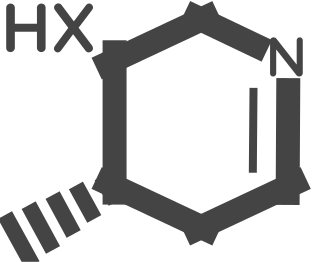 Structure

 P&D probe-likeness score

Structure formats
[[ format ]]
[[ compound[format === 'MOL' ? 'molblock' : format.toLowerCase()] ]]
Description
(extracted from source data)
DESCRIPTION
Higenamine (Norcoclaurine), a ¦Â2-AR agonist with antioxidant capability, is a key component of the Chinese herb aconite root that prescribes for treating symptoms of heart failure in the oriental Asian countries. Higenamine is also a ¦Á1-adrenergic receptor antagonist with hypotensive effect. is a selective LSD1 inhibitor (IC50=1.47 ¦ÌM) that can be isolated from aconite. Higenamine hydrochloride has anti-inflammatory and antibacterial activity. Higenamine protects myocyte Apoptosis and ischemia/reperfusion (I/R) injury through selective activation of beta2-adrenergic receptor (¦Â2-AR). Higenamine also reduces I/R-induced myocardial infarction in mice. Higenamine can attenuate IL-1¦Â-induced Apoptosis through ROS-mediated PI3K/Akt signaling pathway. Higenamine protects brain cells from oxygen deprivation. Higenamine can promote bone formation in osteoporosis through the SMAD2/3 pathway. Higenamine can be used to study cancer, inflammation, cardiorenal syndrome and other diseases[1][2][3][4][5][6][7][8][9][10][11].
DESCRIPTION
Higenamine hydrochloride is a selective LSD1 inhibitor (IC50=1.47 ¦ÌM) that can be isolated from aconite. Higenamine hydrochloride has anti-inflammatory and antibacterial activity. Higenamine (Norcoclaurine) can attenuate IL-1¦Â-induced Apoptosis through ROS-mediated PI3K/Akt signaling pathway. Higenamine hydrochloride protects brain cells from oxygen deprivation. Higenamine can promote bone formation in osteoporosis through the SMAD2/3 pathway. Higenamine hydrochloride can be used to study cancer, inflammation, cardiorenal syndrome and other diseases[1][2][3][4][5][6].
PRICE
29
DESCRIPTION
Higenamine hydrochloride (norcoclaurine HCl) has been demonstrated to be a ??2 adrenoreceptor agonist. Adrenergic receptors, or adrenoceptors, belong to the class of G protein?Ccoupled receptors, and are the most prominent receptors in the adipose membrane, besides also being expressed in skeletal muscle tissue.
DESCRIPTION
Higenamine is a β2 and β1-adrenergic receptor agonist. It is a key component of the Chinese herb aconite root that prescribes for treating symptoms of heart failure in the oriental Asian countries.
(Enamine Bioactive Compounds)
DESCRIPTION
Higenamine hydrochloride (norcoclaurine HCl) has been demonstrated to be a β2 adrenoreceptor agonist. Adrenergic receptors, or adrenoceptors, belong to the class of G protein–coupled receptors, and are the most prominent receptors in the adipose membrane, besides also being expressed in skeletal muscle tissue.
(TargetMol Bioactive Compound Library)
[[ p.pathway_name ]]
[[ compound.targets[tid].gene_name ]]
Compound Sets
10
Cayman Chemical Bioactives
ChEMBL Drugs
DrugBank
DrugMatrix
Enamine Bioactive Compounds
Enamine BioReference Compounds
ReFrame library
Selleckchem Bioactive Compound Library
TargetMol Bioactive Compound Library
[[ a.name ]]
[[ ligand_id ]]
free of charge
External IDs
43

Molecular Weight
271.12
Hydrogen Bond Acceptors
4
Hydrogen Bond Donors
4
Rotatable Bonds
2
Ring Count
3
Aromatic Ring Count
2
cLogP
2.23
TPSA
72.72
Fraction CSP3
0.25
Chiral centers
1.0
Largest ring
6.0
QED
0.63

Structural alerts
0
No structural alerts detected

Related compounds
Custom attributes
(extracted from source data)
Target
Adrenergic Receptor
β2-adrenergic receptor
¦Â2-adrenergic receptor
¦Á1-adrenergic receptor
??-adrenoceptor,??1-adrenoceptor
Apoptosis
MAP3K
MDM-2/p53
ROS Kinase
Adrenergic Receptor,Akt,Apoptosis related,PI3K
Pathway
GPCR/G protein
Neuroscience
MAPK/ERK Pathway
Neuronal Signaling
Protein Tyrosine Kinase/RTK
Source data