
General
Preferred name
AVATROMBOPAG
Synonyms
YM477 ()
AKR-501 ()
E5501 ()
As-1670542 ()
Avatrombopag (maleate) ()
Avatrombopag (hydrochloride) ()
AKR-501 (maleate) ()
E5501 (maleate) ()
YM477 (maleate) ()
AKR-501 (hydrochloride) ()
E5501 (hydrochloride) ()
YM477 (hydrochloride) ()
AKR-501,E5501,YM477 ()
AVATROMBOPAG MALEATE ()
YM-301477 ()
YM-477 ()
E-5501 ()
Doptelet ()
E5501 Maleate ()
E-5501 MALEATE ()
P&D ID
PD058745
CAS
570406-98-3
677007-74-8
570403-17-7
Tags
available
drug
Approved by
PMDA
FDA
First approval
2018
Drug indication
Liver disease
Thrombocytopenia
Idiopathic thrombocytopenic purpura
Drug Status
approved
investigational
Max Phase
4.0

Probe control
Probe control not defined

Orthogonal probes
0
No orthogonal probes found

Similar probes
0
No structurally similar probes found
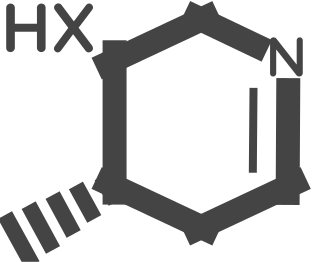 Structure

 P&D probe-likeness score

Structure formats
[[ format ]]
[[ compound[format === 'MOL' ? 'molblock' : format.toLowerCase()] ]]
Description
(extracted from source data)
DESCRIPTION
Avatrombopag is a second generation, small molecule, orally administered thrombopoietin receptor agonist . It was discovered through its ability to mimic the action of endogenous thrombopoietin which is the primary physiological regulator of normal platelet production. There is no INN for this compound.
PHARMACODYNAMICS
In a study of efficacy, avatrombopag resulted in dose and exposure-dependent elevations in platelet counts in adults [A33095]. The onset of the platelet count increase was noted within 3 to 5 days of the start of a 5-day treatment course, with the highest level of effect measured after 10 to 13 days. Following this, platelet counts decreased gradually, returning to near baseline values at the 35-day point [FDA label].; ; Increased platelet activation leads to increased blood clotting, which may lead to various complications [A33110]. Avatrombopag does not lead to increased platelet activation [L2824].
ROE
Fecal excretion accounted for 88% of the administered dose, with 34% of the dose excreted as unchanged avatrombopag. Only 6% of the administered dose was found in urine [FDA label].
MOA
Avatrombopag is an orally bioavailable, small molecule thrombopoietin (TPO) receptor agonist that stimulates proliferation and differentiation of megakaryocytes from bone marrow progenitor cells resulting in an increased production of platelets. Avatrombopag is not competitive with thrombopoietin for binding to the TPO receptor and has an additive pharmacological effect with TPO on platelet production [FDA label].; ; Avatrombopag is a thrombopoietin receptor (TPOR; MPL) agonist, with possible megakaryopoiesis stimulating activity. After administration, avatrombopag binds to and stimulates the platelet thrombopoeitin receptor (TPOR), which can lead to the proliferation and differentiation of megakaryocytes from bone marrow progenitor cells. This process increases the production of platelets and may serve to prevent chemotherapy-induced thrombocytopenia (CIT). TPOR is classified as a cytokine receptor and as a member of the hematopoietin receptor superfamily [L2928].
TOXICITY
The most common adverse reactions reported in at least 3% of patients were pyrexia, abdominal pain, nausea, headache, fatigue, and peripheral edema [L2822], [FDA label]. Hyponatremia was also a rare serious adverse effect of this drug, seen in only 2 patients in the treatment group [FDA label]. Adverse reactions resulting in discontinuation of this drug have been anemia, pyrexia, and myalgia [FDA label].; ; Atrombopag is a thrombopoietin (TPO) receptor agonist, and TPO receptor agonists have been associated with thrombotic and thromboembolic complications in patients with chronic liver disease. Portal venous thrombosis occurrence has been reported in patients with chronic liver disease who are treated with TPO receptor agonists [FDA label]. Patients should be monitored carefully [L2929].
ABSORPTION
Following single dosing under fasted and fed conditions, mean peak concentrations occurred at 5-8 hours and declined with a half-life of 16-18 hours in Japanese and white subjects. Administration with food did not have an effect on the rate or extent of avatrombopag absorption, however, significantly reduced pharmacokinetic variability relative to the fasting state [A33097].; ; Avatrombopag showed dose-proportional pharmacokinetics after single doses from 10 mg (0.25-times the lowest approved dosage) to 80 mg (1.3-times the highest recommended dosage). Healthy subjects administered 40 mg of avatrombopag showed a geometric mean (%CV) maximal concentration (Cmax) of 166 (84%) ng/mL and area under the time-concentration curve, extrapolated to infinity (AUC0-inf) of 4198 (83%) ng.hr/mL. The pharmacokinetics of avatrombopag are similar in both healthy subjects and the chronic liver disease population [FDA label].
DESCRIPTION
Avatrombopag is a second generation, small molecule, orally administered thrombopoietin receptor agonist . It was discovered through its ability to mimic the action of endogenous thrombopoietin which is the primary physiological regulator of normal platelet production. The pharmacokinetics, pharmacodynamics, pharmacogenomics, safety, and tolerability of avatrombopag were reported by Nomoto et al. in 2017 .
(GtoPdb)
DESCRIPTION
Avatrombopag (AKR-501) is an orally active, nonpeptide thrombopoietin (TPO) receptor agonist (EC50=3.3 nM). Avatrombopag mimics the biological activities of TPO. Avatrombopag increases platelet production by activating the intracellular signaling system, and promotes production of platelets and megakaryocytes from hemopoietic precursor cells. Avatrombopag is a substrate of cytochrome P450 (CYP) 2C9 and CYP3A[1][2][3].
PRICE
228
DESCRIPTION
Avatrombopag (AKR-501) maleate is an orally active, non-peptide thrombopoietin receptor (TPO receptor) agonist (EC50: 3.3 nM). Avatrombopag maleate mimics the biological activity of TPO. Avatrombopag maleate increases platelet production by activating intracellular signaling systems and promotes the production of platelets and megakaryocytes from hematopoietic precursor cells. Avatrombopag maleate is a substrate for cytochrome P450 (CYP) 2C9 and CYP3A [1][2][3].
DESCRIPTION
Avatrombopag (AKR-501) hydrochloride is an orally active, nonpeptide thrombopoietin (TPO) receptor agonist (EC50=3.3 nM). Avatrombopag hydrochloride mimics the biological activities of TPO. Avatrombopag hydrochloride increases platelet production by activating the intracellular signaling system, and promotes production of platelets and megakaryocytes from hemopoietic precursor cells. Avatrombopag hydrochloride is a substrate of cytochrome P450 (CYP) 2C9 and CYP3A[1][2][3].
DESCRIPTION
Avatrombopag (YM477) is a new oral thrombopoietin (TPO) receptor agonist, activating TPO receptor and increasing megakaryocytic proliferation/differentiation and platelet production.
(TargetMol Bioactive Compound Library)
[[ p.pathway_name ]]
[[ compound.targets[tid].gene_name ]]

Cell lines
1

Organisms
1

Compound Sets
18
AdooQ Bioactive Compound Library
Cayman Chemical Bioactives
ChEMBL Approved Drugs
ChEMBL Drugs
Drug Repurposing Hub
DrugBank
DrugBank Approved Drugs
DrugCentral
DrugCentral Approved Drugs
DrugMAP
DrugMAP Approved Drugs
Guide to Pharmacology
NCATS Inxight Approved Drugs
Novartis Chemogenetic Library (NIBR MoA Box)
ReFrame library
Selleckchem Bioactive Compound Library
TargetMol Bioactive Compound Library
[[ a.name ]]
[[ ligand_id ]]
free of charge
External IDs
48

Molecular Weight
648.15
Hydrogen Bond Acceptors
9
Hydrogen Bond Donors
2
Rotatable Bonds
7
Ring Count
6
Aromatic Ring Count
3
cLogP
6.58
TPSA
101.9
Fraction CSP3
0.52
Chiral centers
0.0
Largest ring
6.0
QED
0.3

Structural alerts
0
No structural alerts detected

Related compounds
Custom attributes
(extracted from source data)
Target
Thrombopoietin Receptor
TPO
MPL
Cytochrome P450
ERK
STAT
TpoR
Member status
member
MOA
Signal Transduction Modulators
Thrombopoietin Receptor (TpoR) Agonists
thrombopoietin receptor agonist
Indication
thrombocytopenia
Pathway
Immunology/Inflammation
Proteases/Proteasome
JAK/STAT Signaling
MAPK/ERK Pathway
Metabolic Enzyme/Protease
Stem Cell/Wnt
Source data