
General
Preferred name
SRT-1720
Synonyms
SRT 1720 (Hydrochloride) ()
SRT1720 HCl ()
SRT 1720 Hydrochloride ()
SRT1720 ()
SRT 1720 ()
SRT 1720 tetrahydrochloride ()
SRT 1720 (monohydrochloride) ()
SRT 1720 (dihydrochloride) ()
SRT1720 hydrochloride ()
SRT 1720 dihydrochloride ()
P&D ID
PD050847
CAS
1001645-58-4
925434-55-5
2060259-60-9
2468639-77-0
Tags
available
drug candidate
Drug indication
Discovery agent
Drug Status
investigational

Probe control
Probe control not defined

Orthogonal probes
0
No orthogonal probes found

Similar probes
0
No structurally similar probes found
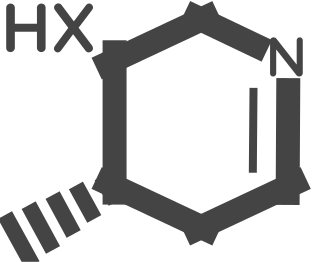 Structure

 P&D probe-likeness score

Structure formats
[[ format ]]
[[ compound[format === 'MOL' ? 'molblock' : format.toLowerCase()] ]]
Description
(extracted from source data)
DESCRIPTION
SRT 1720 monohydrochloride is a selective and orally active activator of SIRT1 with an EC50 of 0.10 ¦ÌM, and shows less potent activities on SIRT2 and SIRT3[1].
PRICE
264
DESCRIPTION
SRT1720 hydrochloride (SRT1720 HCl) is a selective activator of SIRT1 (EC1.5: 0.16 ??M) and shows less potent activities on SIRT2/SIRT3 (EC1.5s: 37 ??M/300 ??M).
DESCRIPTION
SRT1720 is a selective SIRT1 activator. SRT1720 binds to the SIRT1 enzyme–peptide substrate complex at an allosteric site amino-terminal to the catalytic domain . In vivo studies show that SIRT1 activation has the potential to improve insulin sensitivity in animal models of obesity, and improve glucose homeostasis . This indicates the potential of such compounds as treatment for type II diabetes.
(GtoPdb)
PRICE
69
DESCRIPTION
SRT 1720 is a selective activator of human SIRT1 (EC1.5: 0.16 ??M) and exhibits more than 230-fold lower potency for SIRT2 and SIRT3.
DESCRIPTION
SRT 1720 dihydrochloride is a selective and orally active activator of SIRT1 with an EC50 of 0.10 ¦ÌM, and shows less potent activities on SIRT2 and SIRT3[1].
PRICE
179
DESCRIPTION
SRT 1720 dihydrochloride is a selective activator of SIRT1 (EC1.5: 0.16 ??M) and shows less potent activities on SIRT2 (EC1.5: 37 ??M) and SIRT3 (EC1.5: 300 ??M).
DESCRIPTION
SRT1720 hydrochloride (SRT1720 HCl) is a selective activator of SIRT1 (EC1.5: 0.16 μM) and shows less potent activities on SIRT2/SIRT3 (EC1.5s: 37 μM/300 μM).
(TargetMol Bioactive Compound Library)
DESCRIPTION
SRT1720 is a drug developed by Sirtris Pharmaceuticals intended as a small-molecule activator of the sirtuin subtype SIRT1. It has similar activity in the body to the known SIRT1 activator resveratrol, but is 1000x more potent. In animal studies it was found to improve insulin sensitivity and lower plasma glucose levels in fat, muscle and liver tissue, and increased mitochondrial and metabolic function. Although SRT1720 is not currently undergoing clinical development, a related compound, SRT2104, is currently in clinical development for metabolic diseases.
(BOC Sciences Bioactive Compounds)
DESCRIPTION
SRT 1720 is a selective activator of human SIRT1 (EC1.5: 0.16 μM) and exhibits more than 230-fold lower potency for SIRT2 and SIRT3.
(TargetMol Bioactive Compound Library)
DESCRIPTION
SRT 1720 dihydrochloride is a selective activator of SIRT1 (EC1.5: 0.16 μM) and shows less potent activities on SIRT2 (EC1.5: 37 μM) and SIRT3 (EC1.5: 300 μM).
(TargetMol Bioactive Compound Library)
[[ p.pathway_name ]]
[[ compound.targets[tid].gene_name ]]

Cell lines
0

Organisms
1

Compound Sets
15
Axon Medchem Screening Library
BOC Sciences Bioactive Compounds
Cayman Chemical Bioactives
CZ-OPENSCREEN Bioactive Library
Drug Repurposing Hub
DrugBank
DrugMAP
EU-OPENSCREEN Bioactive Compound Library
Guide to Pharmacology
Novartis Chemogenetic Library (NIBR MoA Box)
Other bioactive compounds
Selleckchem Bioactive Compound Library
[[ a.name ]]
[[ ligand_id ]]
free of charge
External IDs
44

Molecular Weight
469.17
Hydrogen Bond Acceptors
8
Hydrogen Bond Donors
2
Rotatable Bonds
5
Ring Count
6
Aromatic Ring Count
5
cLogP
3.66
TPSA
87.45
Fraction CSP3
0.2
Chiral centers
0.0
Largest ring
6.0
QED
0.41

Structural alerts
0
No structural alerts detected

Related compounds
Custom attributes
(extracted from source data)
Target
Autophagy
Sirtuin
SIRT1
SIRT2
SIRT1 activator
Autophagy,Sirtuin
Pathway
Epigenetics
Cell Cycle/DNA Damage
Chromatin/Epigenetic
DNA Damage/DNA Repair
Member status
member
MOA
Histone Deacetylase SIRT1 Activators
SIRT activator
Source data