
General
Preferred name
ecopipam
Synonyms
Sch-39166 ()
UNII-0X748O646K ()
SCH 39166 ()
SCH 39166 hydrobromide ()
Ecopipam (hydrochloride) ()
SCH 39166 (hydrochloride) ()
ECOPIPAM HYDROCHLORIDE ()
Ecopipam hcl ()
SCH-39166 ()
SCH 39166 (hydrobromide) ()
P&D ID
PD049447
CAS
1227675-51-5
112108-01-7
125652-14-4
190133-94-9
Tags
available
drug candidate
Drug indication
gambling behaviour
Tourette syndrome
Cocaine addiction
Drug Status
investigational
Max Phase
3.0

Probe control
Probe control not defined

Orthogonal probes
0
No orthogonal probes found

Similar probes
0
No structurally similar probes found
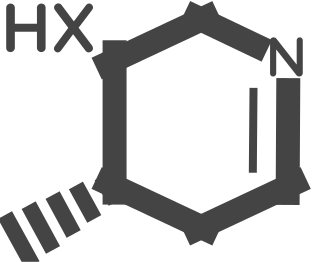 Structure

 P&D probe-likeness score

Structure formats
[[ format ]]
[[ compound[format === 'MOL' ? 'molblock' : format.toLowerCase()] ]]
Description
(extracted from source data)
DESCRIPTION
Ecopipam is an orally bioactive, brain penetrant dopamine receptor antagonist , with selectivity for the D1/5 subtypes . It is structurally related to benzazepine. Ecopipam has been utilised to demonstrate (in animal models) the potential of D1 receptor antagonism to rescue autistic-like behaviours that are associated with the lysosomal storage disorder mucopolysaccharidosis type IIIA-D (MPS-IIIA-D) .
(GtoPdb)
PRICE
501
DESCRIPTION
Ecopipam (UNII-0X748O646K) is a potent, selective, and orally active antagonist of dopamine D1/D5 receptors, with Kis of 1.2 nM and 2.0 nM, respectively. Ecopipam demonstrates more than 40-fold selectivity over D2, D4, 5-HT, and ??2a receptors (Ki=0.98, 5.52, 0.08, and 0.73 ??M, respectively). It is used in research on schizophrenia and obesity.
DESCRIPTION
Ecopipam (SCH 39166) hydrochloride is a potent, selective and orally active antagonist of dopamine D1/D5 receptor, with Kis of 1.2 nM and 2.0 nM, respectively. Ecopipam hydrochloride shows more than 40-flod selectivity over D2, D4, 5-HT, and ¦Á2a receptor (Ki=0.98, 5.52, 0.08, and 0.73 ¦ÌM, respectively). Ecopipam hydrochloride can be used for the research of schizophrenia and obesity[1][3].
DESCRIPTION
Ecopipam, a synthetic benzazepine derivative drug, acts as a selective dopamine D1/D5 receptor antagonist with little affinity for either dopamine D2-like or 5-HT2 receptors. It was developed by Schering plough. It is currently in clinical trials conducted by the biotechnology company Psyadon Pharmaceuticals for the treatment of Tourette syndrome in children. It has received FDA treatment of Lesch-Nyhan disease orphan drug certification.
(BOC Sciences Bioactive Compounds)
DESCRIPTION
Ecopipam (UNII-0X748O646K) is a potent, selective, and orally active antagonist of dopamine D1/D5 receptors, with Kis of 1.2 nM and 2.0 nM, respectively. Ecopipam demonstrates more than 40-fold selectivity over D2, D4, 5-HT, and α2a receptors (Ki=0.98, 5.52, 0.08, and 0.73 μM, respectively). It is used in research on schizophrenia and obesity.
(TargetMol Bioactive Compound Library)
DESCRIPTION
Selective, orally active CCK1 receptor antagonist
(Tocris Bioactive Compound Library)
DESCRIPTION
SCH 39166 hydrobromide is a high affinity dopamine D1/D5 receptor antagonist (Ki = 1.2, 2, 980, 5520, 80 and 731 nM for binding to D1, D5, D2, D4, 5-HT and α2a receptors, respectively). SCH 39166 is used in the treatment of schizophrenia, cocaine addiction and obesity.
(BOC Sciences Bioactive Compounds)
[[ p.pathway_name ]]
[[ compound.targets[tid].gene_name ]]

Compound Sets
16
BOC Sciences Bioactive Compounds
Cayman Chemical Bioactives
ChEMBL Drugs
Concise Guide to Pharmacology 2017/18
Concise Guide to Pharmacology 2019/20
Concise Guide to Pharmacology 2021/22
Concise Guide to Pharmacology 2023/24
DrugBank
DrugMAP
Guide to Pharmacology
LSP-MoA library (Laboratory of Systems Pharmacology)
Novartis Chemogenetic Library (NIBR MoA Box)
ReFrame library
TargetMol Bioactive Compound Library
Tocris Bioactive Compound Library
[[ a.name ]]
[[ ligand_id ]]
free of charge
External IDs
52

Molecular Weight
313.12
Hydrogen Bond Acceptors
2
Hydrogen Bond Donors
1
Rotatable Bonds
0
Ring Count
4
Aromatic Ring Count
2
cLogP
3.98
TPSA
23.47
Fraction CSP3
0.37
Chiral centers
2.0
Largest ring
7.0
QED
0.79

Structural alerts
0
No structural alerts detected

Related compounds
Custom attributes
(extracted from source data)
Target
Dopamine Receptor
5-HT Receptor
Adrenergic Receptor
Primary Target
D1 and D5 Receptors
MOA
Antagonist
selective dopamine D1/D5 receptor antagonist
Member status
member
Pathway
GPCR/G protein
Neuronal Signaling
Neuroscience
Solubility
10 mM in DMSO
Source data