
General
Preferred name
GSK484
Synonyms
((3S,4R)-3-Amino-4-hydroxypiperidin-1-yl)(2-(1-(cyclopropylmethyl)-1H-indol-2-yl)-7-methoxy-1-methyl-1H-benzo[d]imidazol-5-yl)methanone, hydrochloride ()
GTPL8577 ()
AOB6992 ()
GSK 484 ()
GSK484 (hydrochloride) ()
GSK484 hydrochloride ()
GSK-484 ()
GSK484 HCl ()
P&D ID
PD036142
CAS
1652591-81-5
Tags
available
probe

Probe info
Probe type
calculated probe
experimental probe
Probe sources
Probe targets
[[ compound.targets[t].gene_name ]]

Probe control

Orthogonal probes
1
No orthogonal probes found

Similar probes
0
No structurally similar probes found
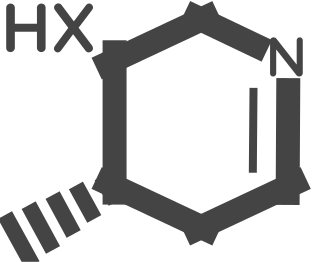 Structure

 P&D probe-likeness score

Structure formats
[[ format ]]
[[ compound[format === 'MOL' ? 'molblock' : format.toLowerCase()] ]]
Description
(extracted from source data)
DESCRIPTION
GSK484 hydrochloride is a selective and reversible peptidylarginine deiminase 4 (PAD4) inhibitor. GSK484 hydrochloride demonstrates high affinity binding to PAD4 with IC50s of 50 nM in the absence of Calcium. In the presence of 2 mM Calcium, notably lower potency (250 nM) is observed.
PRICE
242
DESCRIPTION
GSK484 binds to peptidyl arginine deiminase, type IV (PADI4; Q9UM07) and inhibits its activity . PADI4 contributes to regulating the histone code by effecting the citrullination/deimination of histones. PADI4 has strong associations with cancer and immune and inflammatory processes. GSK484 will be a useful tool to enhance understanding of the normal and pathological functions of PADI4.
This is a compound from the Structural Genomics Consortium's (SGC) Epigenetics Probes Collection, developed in collaboration with GlaxoSmithKline (GSK).
This is a compound from the Structural Genomics Consortium's (SGC) Epigenetics Probes Collection, developed in collaboration with GlaxoSmithKline (GSK).
COMMENT
GSK484 is a PADI4-selective in vitro chemical probe. PAD4 is a calcium-dependent enzyme which catalyzes the reaction in which protein arginine residues are converted into citrulline, with the release of ammonia. This pathway is anticipated to be relevant to multiple immune and inflammatory processes, oncology, and the regulation of stem cell maintenance. GSK484 reversibly binds to the low-calcium form of PAD4 (IC50 = 50 nM, mouse neutrophils) and has been shown to be selective over PAD1-3 in cellular assays and with assays employing recombinant enzymes. The probe has been studied in cells but has not been evaluated with in vivo models. It is not clear that the probe will function in vivo due to the need for low concentrations of calcium to render the target in optimal form for binding. This may be difficult to achieve in a physiological model. Dec 26 2016 - 12:07pm; There is solid experimental evidence supporting GSK484 as a PAD4-specific inhibitor in biochemical systems, including nanomolar potencies in fluorescence polarization, ligand-competition, and NH3-release assays, X-ray crystallography, and convincing SAR. Users should note GSK484 is significantly more active in the absence of calcium-bound PAD4. Mass spectrometry and dialysis experiments support a reversible, competitive binding mechanism in the absence of calcium and a more complicated mode of action at higher calcium concentrations. 50-target biochemical activity profiling demonstrates reasonable selectivity compared to unrelated proteins in vitro. There is also solid experimental evidence supporting GSK484 as a relatively PAD4-specific inhibitor in certain cell-based systems, including Western blotting, cell imaging, and chemoproteomic mass spectrometry. Note there is an approximately 10-20-fold decrease in potency in most cell-based experiments, which could be due to a variety of factors including calcium status, intracellular concentration, and nonspecific protein binding, and parameters of the biochemical assays, among others. GSK484 is relatively nontoxic to certain cell lines at 10 uM. Users should also note that while the original manuscript presents biochemical and cellular selectivity data for PAD1-4 but not PAD6. There is an inactive analog, GSK106. I would highly recommend including this control compound in any experiments utilizing GSK484. I recommend this probe for use in cell-based systems, with the caution to carefully consider calcium concentrations when designing and interpreting experiments. Depending on the experimental question, I would also consider monitoring the contributions of the related PDA1-3 and PDA6, since there is always potential for other PDA engagement in cell-based systems. The original report does not provide data regarding use in model organisms, so it is unclear how GSK484 may engage PDA4 in complex organisms given its calcium-dependent activity. I do not endorse this compound for use in animal models, though additional data demonstrating useful (e.g., potent, selective, consistent with proposed mechanism of action) target engagement in vivo may enable a future recommendation. Jul 10 2017 - 12:05pm
DESCRIPTION
GSK484 binds to peptidyl arginine deiminase, type IV (PADI4; Q9UM07) and inhibits its activity . PADI4 contributes to regulating the histone code by effecting the citrullination/deimination of histones. PADI4 has strong associations with cancer and immune and inflammatory processes. GSK484 will be a useful tool to enhance understanding of the normal and pathological functions of PADI4.
This is a compound from the Structural Genomics Consortium's (SGC) Epigenetics Probes Collection, developed in collaboration with GlaxoSmithKline (GSK). (GtoPdb)
This is a compound from the Structural Genomics Consortium's (SGC) Epigenetics Probes Collection, developed in collaboration with GlaxoSmithKline (GSK). (GtoPdb)
MOA
Mixed-mode inhibitor
(Chemical Probes.org)
DESCRIPTION
GSK484 hydrochloride (GTPL8577) is a reversible peptidyl-arginine deiminase 4 (PAD4) inhibitor. It binds to PAD4 with high affinity, with IC50 of 250 and 50 nM in the presence and absence of 2 mM calcium, respectively. GSK484 promotes the radiosensitivity of colorectal cancer (CRC) and inhibits NET formation in vitro and in vivo.
(TargetMol Bioactive Compound Library)
DESCRIPTION
GSK-484 is a potent protein-arginine deiminase type-4 (PAD-4) inhibitor.
(BOC Sciences Bioactive Compounds)
[[ p.pathway_name ]]
[[ compound.targets[tid].gene_name ]]

Compound Sets
16
BOC Sciences Bioactive Compounds
Cayman Chemical Bioactives
Chemical Probes.org
CZ-OPENSCREEN Bioactive Library
EU-OPENSCREEN Bioactive Compound Library
EUbOPEN Chemogenomics Library
Guide to Pharmacology
High-quality chemical probes
Mcule NIBR MoA Box Subset
MedChem Express Bioactive Compound Library
Nature Chemical Biology Probes
Novartis Chemogenetic Library (NIBR MoA Box)
Selleckchem Bioactive Compound Library
SGC Probes
TargetMol Bioactive Compound Library
Tool Compound Set
[[ a.name ]]
[[ ligand_id ]]
free of charge
External IDs
19

Molecular Weight
473.24
Hydrogen Bond Acceptors
7
Hydrogen Bond Donors
2
Rotatable Bonds
5
Ring Count
6
Aromatic Ring Count
4
cLogP
3.15
TPSA
98.54
Fraction CSP3
0.41
Chiral centers
2.0
Largest ring
6.0
QED
0.46

Structural alerts
0
No structural alerts detected

Related compounds
Custom attributes
(extracted from source data)
Target
Protein-arginine deiminase type-4
PAD4
Protein Arginine Deiminase
PAD
PADI4
Member status
member
MOA
PAD4 (Protein-arginine deiminase type-4) substrate competitive reversible inhibitor
Target class
Epigenetics
Epigenetic
Pathway
Chromatin/Epigenetic
Solubility
Soluble in DMSO
Protein Family
Arginine deiminases
Target subclass
Arginine deaminase
Control
GSK106
Recommended Cell Concentration
1 uM
Source data