
General
Preferred name
PD022025
Synonyms
7-CHLOROKYNURENIC ACID ()
7-chloro-4-hydroxy-2-carboxyquinoline ()
7-CKA ()
7-Chlorokynurenic acid sodium salt ()
7-Chlorokynurenic acid (sodium salt) ()
7-CKA (sodium salt) ()
Kynurenic acid, 7-chloro- ()
NSC-149792 ()
P&D ID
PD022025
CAS
18000-24-3
1263094-00-3
Tags
available
drug candidate

Probe control
Probe control not defined

Orthogonal probes
0
No orthogonal probes found

Similar probes
0
No structurally similar probes found
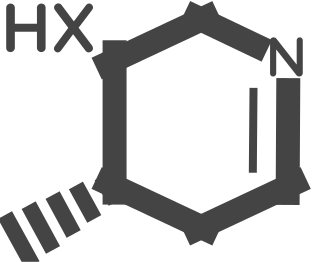 Structure

 P&D probe-likeness score
Structure formats
[[ format ]]
[[ compound[format === 'MOL' ? 'molblock' : format.toLowerCase()] ]]
Description
(extracted from source data)
DESCRIPTION
7-Chlorokynurenic acid (7-CKA) is a potent and selective antagonist of the glycine B coagonist site of the N-methyl-D-aspartate (NMDA) receptor (IC50=0.56 ¦ÌM). 7-Chlorokynurenic acid is also a potent inhibitor of the reuptake of glutamate into synaptic vesicles with a Ki of 0.59 ¦ÌM. 7-Chlorokynurenic acid has potent antinociceptive actions after neuraxial delivery[1][2].
PRICE
31
DESCRIPTION
7-Chlorokynurenic acid (7-chloro-4-hydroxy-2-carboxyquinoline) is an effecitve and selective antagonist of NMDA receptor with IC50 of 0.56 ??M for the glycine B coagonist site. 7-Chlorokynurenic acid inhibits the reuptake of glutamate into synaptic vesicles with a Ki of 0.59 ??M and shows antinociceptive actions after neuraxial delivery.
DESCRIPTION
7-Chlorokynurenic acid sodium salt (7-CKA sodium salt) is a potent and selective antagonist of the glycine B coagonist site of the N-methyl-D-aspartate (NMDA) receptor (IC50=0.56 ¦ÌM). 7-Chlorokynurenic acid sodium salt is also a potent inhibitor of the reuptake of glutamate into synaptic vesicles with a Ki of 0.59 ¦ÌM. 7-Chlorokynurenic acid sodium salt has potent antinociceptive actions after neuraxial delivery[1][2].
DESCRIPTION
Transportable EAAT1-4 inhibitor/non-transportable EAAT5 inhibitor
(Tocris Bioactive Compound Library)
DESCRIPTION
Potent competitive inhibitor of L-glutamate uptake
(Tocriscreen Plus)
DESCRIPTION
Potent competitive inhibitor of L-glutamate uptake
(Tocriscreen Total)
DESCRIPTION
7-Chlorokynurenic acid is a water-soluble and very potent NMDA receptor antagonist acting at the strychnine-insensitive glycine binding site. It is also a potent competitive inhibitor of L-glutamate transport into synaptic vesicles. It is used in studies of schizophrenia and neuroprotection.
(BOC Sciences Bioactive Compounds)
DESCRIPTION
7-Chlorokynurenic acid (7-chloro-4-hydroxy-2-carboxyquinoline) is an effecitve and selective antagonist of NMDA receptor with IC50 of 0.56 μM for the glycine B coagonist site. 7-Chlorokynurenic acid inhibits the reuptake of glutamate into synaptic vesicles with a Ki of 0.59 μM and shows antinociceptive actions after neuraxial delivery.
(TargetMol Bioactive Compound Library)
DESCRIPTION
Selective MRP1 and P-gp inhibitor
(Tocris Bioactive Compound Library)
DESCRIPTION
7-Chlorokynurenic acid sodium salt is the sodium salt of 7-Chlorokynurenic acid, which is a water-soluble and very potent NMDA receptor antagonist acting at the strychnine-insensitive glycine binding site with IC50 value of 0.56 µM. It is also a potent competitive inhibitor of L-glutamate transport into synaptic vesicles. It is used in studies of schizophrenia and neuroprotection.
(BOC Sciences Bioactive Compounds)
[[ p.pathway_name ]]
[[ compound.targets[tid].gene_name ]]
Cell lines
0

Organisms
1
Compound Sets
10
BOC Sciences Bioactive Compounds
Cayman Chemical Bioactives
ChEMBL Drugs
Drug Repurposing Hub
DrugMatrix
MedChem Express Bioactive Compound Library
TargetMol Bioactive Compound Library
Tocriscreen Plus
Tocriscreen Total
[[ a.name ]]
[[ ligand_id ]]
free of charge
External IDs
40
Molecular Weight
223.0
Hydrogen Bond Acceptors
3
Hydrogen Bond Donors
2
Rotatable Bonds
1
Ring Count
2
Aromatic Ring Count
2
cLogP
2.29
TPSA
70.42
Fraction CSP3
0.0
Chiral centers
0.0
Largest ring
6.0
QED
0.78

Structural alerts
0
No structural alerts detected

Related compounds
Custom attributes
(extracted from source data)
Target Type
Transporters
Target
Glutamate receptor
NMDA Receptor
GRIN1, GRIN2A, GRIN2B, GRIN2C
iGluR
Primary Target
Glutamate (EAAT) Transporters
MOA
Inhibitor
glutamate receptor antagonist
Pathway
Neuroscience
Membrane Transporter/Ion Channel
Neuronal Signaling
Source data