
General
Preferred name
trans-trismethoxy Resveratrol
Synonyms
E-Resveratrol Trimethyl Ether ()
MR-3 ()
Tri-O-methylresveratrol ()
3,4',5-Trimethoxy-trans-stilbene ()
Trimethoxystilbene ()
TRISMETHOXYRESVERATROL ()
trans-Trimethoxyresveratrol ()
(E)-Resveratrol trimethyl ether ()
trans-3,5,4'-Trimethoxystilbene ()
3,5,4'-Trimethoxystilbene ()
trans-trismethoxy Resveratrol-d4 ()
P&D ID
PD021396
CAS
22255-22-7
1089051-64-8
Tags
available
drug candidate
Drug indication
Discovery agent

Probe control
Probe control not defined

Orthogonal probes
0
No orthogonal probes found

Similar probes
0
No structurally similar probes found
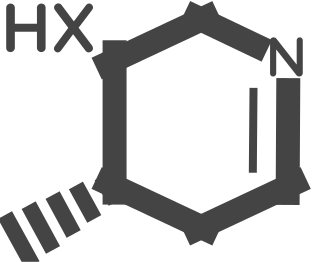 Structure

 P&D probe-likeness score

Structure formats
[[ format ]]
[[ compound[format === 'MOL' ? 'molblock' : format.toLowerCase()] ]]
Description
(extracted from source data)
DESCRIPTION
Trans-Trimethoxyresveratrol is a derivative of Resveratrol (RSV),and it may be a more potent anti-inflammatory, antiangiogenic and vascular-disrupting agent when compared with resveratrol.;In vitro: The in vitro study of resveratrol and trans-Trimethoxyresveratrol showed rather weak cytotoxic effects on three cancer cell lines (HepG2, MCF-7, and MDA-MB-231), which contradicted a previous study reporting that resveratrol inhibited MCF-7 cells with an IC50 of about 10 ¦ÌM. This discrepancy might be explained by the fact that the measurements were made 24 h after drug treatment, whereas the measurements of the previous study were taken 6 days after. The fact that the cytotoxic effect of trans-Trimethoxyresveratrol was lower than that of resveratrol is surprising, because in many studies, trans-Trimethoxyresveratrol is the most active analogue of resveratrol , although resveratrol shows much stronger antioxidant effects than that of trans-Trimethoxyresveratrol.[1];In vivo: Zebrafish embryos offer great advantage over their adults as well as other in vivo models because of the external development and optical transparency during their first few days, making them invaluable in the inspection of developmental processes. These unique advantages can even be made more useful when specific cell types are labeled with fluorescent probes. Zebrafish embryo in vivo, suggests that trans-Trimethoxyresveratrol has both more potent antiangiogenic activity and more importantly, stronger specific cytotoxic effects on endothelial cells than does resveratrol.[1]
PRICE
29
DESCRIPTION
trans-Trimethoxyresveratrol (MR-3), a natural methoxylated analog of resveratrol, inhibits breast Y cell invasiveness by downregulation of PI3K/Akt and Wnt/??-catenin signaling cascades and reversal of epithelial-mesenchymal transition.
DESCRIPTION
trans-Trimethoxyresveratrol (MR-3), a natural methoxylated analog of resveratrol, inhibits breast Y cell invasiveness by downregulation of PI3K/Akt and Wnt/β-catenin signaling cascades and reversal of epithelial-mesenchymal transition.
(TargetMol Bioactive Compound Library)
[[ p.pathway_name ]]
[[ compound.targets[tid].gene_name ]]

Cell lines
17

Organisms
1
Compound Sets
7
CZ-OPENSCREEN Bioactive Library
DrugMAP
EU-OPENSCREEN Bioactive Compound Library
MedChem Express Bioactive Compound Library
Selleckchem Bioactive Compound Library
TargetMol Bioactive Compound Library
[[ a.name ]]
[[ ligand_id ]]
free of charge
External IDs
25

Molecular Weight
270.13
Hydrogen Bond Acceptors
3
Hydrogen Bond Donors
0
Rotatable Bonds
5
Ring Count
2
Aromatic Ring Count
2
cLogP
3.88
TPSA
27.69
Fraction CSP3
0.18
Chiral centers
0.0
Largest ring
6.0
QED
0.77

Structural alerts
1
Nonspecific/NOS
Resveratrols
Nuisance compounds

Related compounds
Custom attributes
(extracted from source data)
Pathway
NF-¦ÊB
Immunology/Inflammation
Metabolic Enzyme/Protease
NF-κB
Protein Tyrosine Kinase/RTK
Metabolism
Target
Reactive Oxygen Species
Apoptosis
Caspase
Reactive Oxygen Species (ROS)
VEGFR
p38 MAPK
Source data