
General
Preferred name
Apilimod
Synonyms
STA 5326 ()
STA 5326 2HCl ()
AIT-101 2HCl ()
Apilimod dimesylate ()
STA-5326 ()
Target 16 ()
Apilimod (mesylate) ()
STA 5326 (mesylate) ()
LAM-002A ()
AIT-101 (mesylate) ()
LAM-002A (free base) ()
AIT-101 ()
STA-5326 mesylate ()
Apilimod mesylate ()
Apilimod (STA-5326) ()
Apilimod (STA-5326) mesylate ()
Apilimod 2HCl ()
P&D ID
PD016725
CAS
870087-36-8
541550-19-0
870087-37-9
Tags
available
drug candidate
Drug indication
Coronavirus Disease 2019 (COVID-19)
Crohn disease
Rheumatoid arthritis
Non-hodgkin lymphoma
Crohn's disease
Drug Status
investigational
Max Phase
2.0

Probe control
Probe control not defined

Orthogonal probes
0
No orthogonal probes found

Similar probes
0
No structurally similar probes found
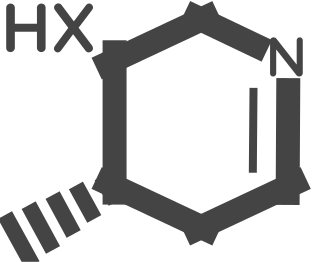 Structure

 P&D probe-likeness score

Structure formats
[[ format ]]
[[ compound[format === 'MOL' ? 'molblock' : format.toLowerCase()] ]]
Description
(extracted from source data)
DESCRIPTION
Apilimod was originally identified as an inhibitor of IL-12/IL-23 production , but the molecular mechanism behind this biological effect was undetermined. Inhibition of IL-12/IL-23 production has application for the treatment Th1-and Th17-mediated immunologic pathologies (which are driven by IL-12 and IL-23 respectively) . Apilimod has subsequently been identified as a selective inhibitor of the type III phosphoinostol kinase, PIKfyve .
We provide structural details for the parent molecule, but some bioactivity data may relate to use of the mesylate salt form as stipulated by the compound's USAN (see PubChem CID 115273300).
PIKfyve has been reported as being required for Ebola virus (EBOV) infection of host cells , and indeed apilimod has anti-EBOV activity in vitro. More broad-spectrum antiviral activity against Lassa virus (LASV), Marburg virus (MARV) and SARS-CoV-2 is supported in the literature. Activity of PIKfyve is markedly modulated by SARS-CoV-2 infection in vitro, and indicates potential hijacking of phosphatidylinositol enzyme activities by the coronavirus . Pharmacological inhibition of this kinase with apilimod has anti-SARS-CoV-2 activity in two model cell lines, A549-ACE2 cells (IC50 7 nM) and Vero E6 cells (IC50 80 nM), and in human iPSC-derived pneumocyte-like cells . A 2022 publication reports that the in vitro inhibition of coronavirus replication by apilimod is not translated to the same activity in a murine model of COVID-19 , and that in fact apilimod worsened symptoms in this model. One explanation for this is that PIKfyve has also been implicated as a key component of antigen presentation by dendritic cells . So in respect of the investigation of apilimod in SARS-CoV-2 infection (NCT04446377), inhibition of antigen presentation, the immune response to new antigens, and T-cell activation, might induce a level of immunosuppression that exacerbates exisiting infection or could increase risk of succumbing to other infections during apilimod treatment . Results from the apilimod clinical trials will be interesting. (GtoPdb)
We provide structural details for the parent molecule, but some bioactivity data may relate to use of the mesylate salt form as stipulated by the compound's USAN (see PubChem CID 115273300).
PIKfyve has been reported as being required for Ebola virus (EBOV) infection of host cells , and indeed apilimod has anti-EBOV activity in vitro. More broad-spectrum antiviral activity against Lassa virus (LASV), Marburg virus (MARV) and SARS-CoV-2 is supported in the literature. Activity of PIKfyve is markedly modulated by SARS-CoV-2 infection in vitro, and indicates potential hijacking of phosphatidylinositol enzyme activities by the coronavirus . Pharmacological inhibition of this kinase with apilimod has anti-SARS-CoV-2 activity in two model cell lines, A549-ACE2 cells (IC50 7 nM) and Vero E6 cells (IC50 80 nM), and in human iPSC-derived pneumocyte-like cells . A 2022 publication reports that the in vitro inhibition of coronavirus replication by apilimod is not translated to the same activity in a murine model of COVID-19 , and that in fact apilimod worsened symptoms in this model. One explanation for this is that PIKfyve has also been implicated as a key component of antigen presentation by dendritic cells . So in respect of the investigation of apilimod in SARS-CoV-2 infection (NCT04446377), inhibition of antigen presentation, the immune response to new antigens, and T-cell activation, might induce a level of immunosuppression that exacerbates exisiting infection or could increase risk of succumbing to other infections during apilimod treatment . Results from the apilimod clinical trials will be interesting. (GtoPdb)
DESCRIPTION
Apilimod (STA 5326) is a potent IL-12/IL-23 inhibitor, and strongly inhibits IL-12 with IC50s of 1 nM and 2 nM, in IFN-¦Ã/SAC-stimulated human PBMCs and SAC-treated monkey PBMCs, respectively[1]. Apilimod is a potent and highly selective PIKfyve inhibitor.
PRICE
59
DESCRIPTION
Apilimod (STA 5326) mesylate is a potent IL-12/IL-23 inhibitor, and strongly inhibits IL-12 with IC50s of 1 nM and 2 nM, in IFN-¦Ã/SAC-stimulated human PBMCs and SAC-treated monkey PBMCs, respectively[1]. Apilimod is a potent and highly selective PIKfyve inhibitor.
PRICE
86
DESCRIPTION
Apilimod mesylate (STA 5326 mesylate) is a potent IL-12/IL-23 inhibitor.
PRICE
1520
DESCRIPTION
Apilimod 2HCl (STA 5326 2HCl) is a PIKFYVE kinase inhibitor that promotes NLRP3 inflammatory vesicle activation, IL-1?? secretion, and cellular pyroptosis, and is used in the study of amyotrophic lateral sclerosis.
DESCRIPTION
Apilimod is a is a strong PIKfyve (1-phosphatidylinositol 3-phosphate 5-kinase) inhibitor with IC50=4 nM. It is also a potent inhibitor of cytokines IL-12 and IL-23 production which are potential regulators of certain autoimmune and inflammatory diseases.
(Enamine Bioactive Compounds)
DESCRIPTION
Apilimod (STA 5326) inhibits the production of IL-12 and IL-23 and reduces dendritic cell infiltration in psoriasis.
(TargetMol Bioactive Compound Library)
DESCRIPTION
Potent and selective doublecortin like kinase 1/2 (DCLK1/2) inhibitor; orally bioavailable
(Tocris Bioactive Compound Library)
DESCRIPTION
Apilimod 2HCl (STA 5326 2HCl) is a PIKFYVE kinase inhibitor that promotes NLRP3 inflammatory vesicle activation, IL-1β secretion, and cellular pyroptosis, and is used in the study of amyotrophic lateral sclerosis.
(TargetMol Bioactive Compound Library)
[[ p.pathway_name ]]
[[ compound.targets[tid].gene_name ]]

Cell lines
3

Organisms
4

Compound Sets
17
AdooQ Bioactive Compound Library
Cayman Chemical Bioactives
ChEMBL Drugs
CZ-OPENSCREEN Bioactive Library
Drug Repurposing Hub
DrugBank
Enamine Bioactive Compounds
Enamine BioReference Compounds
Guide to Pharmacology
Novartis Chemogenetic Library (NIBR MoA Box)
ReFrame library
Selleckchem Bioactive Compound Library
Tocris Bioactive Compound Library
[[ a.name ]]
[[ ligand_id ]]
free of charge
External IDs
35

Molecular Weight
418.21
Hydrogen Bond Acceptors
8
Hydrogen Bond Donors
1
Rotatable Bonds
8
Ring Count
4
Aromatic Ring Count
3
cLogP
3.08
TPSA
84.76
Fraction CSP3
0.3
Chiral centers
0.0
Largest ring
6.0
QED
0.44

Structural alerts
0
No structural alerts detected

Related compounds
Custom attributes
(extracted from source data)
Target
IL-12
IL-23
Interleukin
PIKfyve
IL-1β
Pyroptosis
IL12A
IL-12/23 and PIKfyve inhibitor
IL-12/23 inhibitor
Interleukin Related
Interleukins,PIKfyve
Primary Target
Other Kinases
MOA
Inhibitor
PIKfyve inhibitor
IL-12 Production Inhibitor
PIKFYVE enzyme inhibitor
interleukin synthesis inhibitor
Member status
member
Pathway
Immunology/Inflammation
PI3K/Akt/mTOR signaling
Apoptosis
PI3K/Akt/mTOR
Therapeutic Class
Antiviral Agents
Source data