
General
Preferred name
glycyrrhizic acid
Synonyms
GLYCYRRHIZIN ()
Glycyrrhizic Acid (ammonium salt) ()
Diammonium Glycyrrhizin ()
Glycamil ()
Monoammonium glycyrrhizinate ()
Glycyrram ()
Ammonium Glycyrrhizate ()
Ammonium Glycyrrhizinate ()
Glycyrrhizinic acid ()
Dipotassium glycyrrhizinate ()
Diammonium Glycyrrhizinate ()
Glycyrrhizic acid (dipotassium) ()
Dipotassium glycyrrhizate ()
AMGZ, Glycyram, Glycyrrhizin ammonium salt, Glycyrrhizic acid ammonium salt ()
Glycamil, Glycyrram ()
Neubormitin ()
Glycyrrhizin (NSC 167409) ()
GLYCYRRHIZINATE DIPOTASSIUM ()
.beta.-glycyrrhizin ()
E958 ()
Glycyrrhizate ()
Glycyrrhizinate ()
NSC-167409 ()
Potenlini ()
NSC-234419 ()
18.beta.-glycyrrhizic acid ()
Glycyron ()
Glycyrrhizic acid dipotassium ()
P&D ID
PD014506
CAS
53956-04-0
1407-03-0
139014-59-8
79165-06-3
68797-35-3
132215-36-2
1405-86-3
Tags
available
drug
drug candidate
natural product
nuisance
Approved by
FDA
Drug indication
Chronic kidney disease
Influenza virus infection
Drug Status
investigational
approved
experimental
Max Phase
2.0

Probe control
Probe control not defined

Orthogonal probes
0
No orthogonal probes found

Similar probes
0
No structurally similar probes found
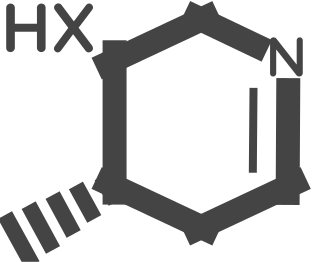 Structure

 P&D probe-likeness score

Structure formats
[[ format ]]
[[ compound[format === 'MOL' ? 'molblock' : format.toLowerCase()] ]]
Description
(extracted from source data)
DESCRIPTION
Ammonium glycyrrhizinate (Monoammonium glycyrrhizinate) has various pharmacological actions such as anti-inflammatory, antiallergic, antigastriculcer, and antihepatitis activities.
PRICE
29
DESCRIPTION
Ammonium Glycyrrhizinate (Glycyram) inhibits the cytopathology and growth of several unrelated DNA/RNA viruses.
PHARMACODYNAMICS
Glycyrrhizic acid was reported to present antiallergic, antiviral and anti-inflammatory activities as well as improvements in glucose tolerance.[A33062] ; ; The effect of glycyrrhizic acid in metabolic syndrome generates a significant decrease in blood glucose, fasting blood glucose and mean serum insulin concentration.[A33063]
MOA
Glycyrrhizic acid can be found in the alpha and beta forms. The alpha form is predominant in the liver and duodenum and thus, it is thought that the anti-inflammatory liver effect of this drug are mainly due to the action of this isomer. Glycyrrhizic acid anti-inflammatory effect is generated via suppression of TNF alpha and caspase 3. It also inhibits the translocation of NFkB into the nuclei and conjugates free radicals. Some studies have shown a glycyrrhizic-driven inhibition of CD4+ T cell proliferation via JNK, ERK and PI3K/AKT.[A33062]; ; The antiviral activity of glycyrrhizic acid includes the inhibition of viral replication and immune regulation.[A33062] The antiviral activity of glycyrrhizic acid seems to be of a broad spectrum and be able to cover several different viral types such as vaccinia virus, herpes simplex virus, Newcastle disease virus and vesicular stomatitis virus.[A33063]; ; The effect of glycyrrhizic acid on metabolism is thought to be related to its inhibitory activity towards 11-beta-hydroxysteroid dehydrogenase type 1 which in turn decreases the activity of hexose-6-phosphate dehydrogenase. On the other hand, some studies have shown a potential lipoprotein lipase induction in non-hepatic tissues and thus it is suggested to enhance dyslipidemic conditions.[A33063]
TOXICITY
Glycyrrhizic acid is thought to generate inhibition of 11-beta-hydroxysteroid dehydrogenase in the kidney which leads to elevated cortisol levels in the kidney. Intravenous administration of the ammoniated form was shown to produce convulsions and hemolysis.[F79]; ; Preclinical overdose studies have been shown to produce mineralocorticoid excess. The LD50 in preclinical studies was reported to be in the range of 308-12700 mg/kg.[F79] ; ; Glycyrrhizic acid has been proven to not have mutagenic, genotoxic, teratogenic nor carcinogenic effects.[F79]
ROE
Glycyrrhizic acid presents a biphasic elimination from the central compartment with a dose-dependent second elimination phase. The majority of the administered dose is eliminated by the bile in which glycyrrhizic acid can be eliminated unchanged and undergoes enterohepatic cycling.[A33066] On the other hand, the major metabolite, glycyrrhetinic acid, forms glucuronide and sulfate conjugates. These conjugates are efficiently transported into the bile and duodenum where commensal bacteria hydrolizes the conjugate for the formation of glycyrrhetinic acid and further reabsorption.[A33064] This reabsorption behavior seems to be related to the activity of 3-alpha-hydroxysteroid dehydrogenase which transports very efficiently the metabolite from the plasma to the bile.[A33068]; ; About 1.1-2.5% of the administered dose of glycyrrhizic acid can be found in urine which corresponds to the minimal cycling and reabsorption of this compound.[A33067]
PRICE
29
DESCRIPTION
Glycyrrhizic acid is a triterpenoid saponinl, acting as a direct HMGB1 antagonist, with anti-tumor, anti-diabetic activities.
DESCRIPTION
Diammonium Glycyrrhizinate, isolated from the licorice root, is a widely used anti-inflammatory agent[1].
PRICE
29
DESCRIPTION
Diammonium Glycyrrhizinate (Glycyrrhizin) , an extensively used anti-inflammatory agent, is isolated from the licorice root. It is metabolized to glycyrrhetinic acid, which inhibits 11-??-hydroxysteroid dehydrogenase and other enzymes involved in the metabolism of corticosteroids. Therefore, glycyrrhizic acid, the main and sweet component of licorice, has been studied for its ability to cause hypermineralocorticoidism with potassium loss and sodium retention, edema, increased blood pressure, as well as inhibited the renin-angiotensin-aldosterone system.
DESCRIPTION
Dipotassium glycyrrhizinate is a HMGB1 inhibitor, inhibits atopic dermatitis-related gene expression with anti-anti-inflammatory activity[1][2][3].
PRICE
29
DESCRIPTION
Ammonium glycyrrhizinate (Glycyrram) exhibits diverse pharmacological properties, including anti-inflammatory, antiallergic, antigastriculcer, and antihepatitis activities.
(TargetMol Bioactive Compound Library)
DESCRIPTION
Glycyrrhizic acid (Glycyrrhizin) is a triterpenoid saponinl with anti-tumor and anti-diabetic activities.
(TargetMol Bioactive Compound Library)
DESCRIPTION
Diammonium Glycyrrhizinate (Glycyrrhizin) , an extensively used anti-inflammatory agent, is isolated from the licorice root. It is metabolized to glycyrrhetinic acid, which inhibits 11-β-hydroxysteroid dehydrogenase and other enzymes involved in the metabolism of corticosteroids. Therefore, glycyrrhizic acid, the main and sweet component of licorice, has been studied for its ability to cause hypermineralocorticoidism with potassium loss and sodium retention, edema, increased blood pressure, as well as inhibited the renin-angiotensin-aldosterone system.
(TargetMol Bioactive Compound Library)
DESCRIPTION
Dipotassium glycyrrhizinate is an anionic surfactant having anti-allergic and anti-inflammatory activities.
(TargetMol Bioactive Compound Library)
[[ p.pathway_name ]]
[[ compound.targets[tid].gene_name ]]

Cell lines
5

Organisms
4
Compound Sets
23
A Collection of Useful Nuisance Compounds (CONS) for Interrogation of Bioassay Integrity
Cayman Chemical Bioactives
ChEMBL Drugs
Concise Guide to Pharmacology 2017/18
Concise Guide to Pharmacology 2019/20
Concise Guide to Pharmacology 2021/22
Concise Guide to Pharmacology 2023/24
Drug Repurposing Hub
DrugBank
DrugBank Approved Drugs
DrugCentral
DrugCentral Approved Drugs
DrugMAP
Guide to Pharmacology
LSP-MoA library (Laboratory of Systems Pharmacology)
Novartis Chemogenetic Library (NIBR MoA Box)
NPC Screening Collection
Nuisance compounds in cellular assays
ReFrame library
Selleckchem Bioactive Compound Library
[[ a.name ]]
[[ ligand_id ]]
free of charge
External IDs
106

Molecular Weight
822.4
Hydrogen Bond Acceptors
13
Hydrogen Bond Donors
8
Rotatable Bonds
7
Ring Count
7
Aromatic Ring Count
0
cLogP
2.25
TPSA
267.04
Fraction CSP3
0.86
Chiral centers
19.0
Largest ring
6.0
QED
0.17

Structural alerts
1
Saponin/tannin
Detergent-like effects
Nuisance compounds

Related compounds
Custom attributes
(extracted from source data)
Target
Dehydrogenase
MAO
Virus Protease
11-beta-hydroxysteroid dehydrogenase
HSD11B1, HSD11B2, SLCO1B1, SLCO1B3
NF-κB
Reactive Oxygen Species (ROS)
Dehydrogenase,High-mobility Group
Dehydrogenase,High-mobility Group,MAO
Immunology & Inflammation related
MOA
Dehydrogenase inhibitor
Inhibitors of Blood Coagulation Pathways
thrombin inhibitors
Antioxidants
Cell Adhesion Inhibitors
Thrombin inhibitor
Member status
member
Indication
cosmetic
Pathway
Anti-infection
Immunology/Inflammation
Metabolic Enzyme/Protease
Metabolism
Microbiology/virology
Neuroscience
Nuisance MOA
Saponin
Targets
HMGB1
SARS-associated coronavirus
Source data