
General
Preferred name
QUIPAZINE
Synonyms
QUIPAZINE MALEATE ()
Quipazine dimaleate ()
Quipazine dimaleate salt ()
Quipazine Dihydrochloride ()
Azaperone (dimaleate) ()
Quipazine (maleate) ()
Quipazine (dimaleate) ()
2-(piperazin-1-yl)quinoline ()
NSC-758469 ()
MA-1291 ()
MA 1291 ()
Quipazina ()
Quizapine dihydrochloride ()
QUIPAZINA ()
P&D ID
PD013226
CAS
5786-68-5
4774-24-7
150323-78-7
928026-67-9
1245646-84-7
Tags
available
drug candidate
Drug indication
Discovery agent
Drug Status
investigational
Max Phase
2.0

Probe control
Probe control not defined

Orthogonal probes
0
No orthogonal probes found

Similar probes
0
No structurally similar probes found
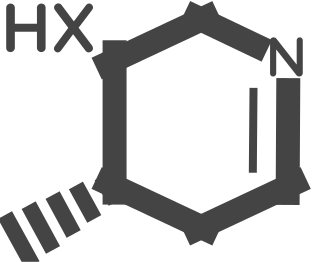 Structure

 P&D probe-likeness score

Structure formats
[[ format ]]
[[ compound[format === 'MOL' ? 'molblock' : format.toLowerCase()] ]]
Description
(extracted from source data)
DESCRIPTION
Quipazine maleate is a 5-HT agonist that causes behavioural changes such as hyperactivity. Quipazine maleate also shows a weak reversible MAO inhibitory activity[1].
PRICE
29
DESCRIPTION
Quipazine dimaleate is a 5-HT agonist with a Ki value of 1.4 nM for displaces [3H]GR65630 from 5-HT3R in rat. Quipazine dimaleate shows antiviral activity against SARS-CoV-2 with an EC50 of 31.64 ¦ÌM. Quipazine dimaleate behaves as a 5-HT3R antagonist in peripheral models. Quipazine dimaleate can be used for neurological disease research[1][2][3][4].
DESCRIPTION
Quipazine belongs to the piperazine family of compounds and may act to improve function of the spinal nerve circuitry .
(GtoPdb)
DESCRIPTION
Quipazine is a 5-HT agonist with a Ki value of 1.4 nM for displaces [3H]GR65630 from 5-HT3R in rat. Quipazine shows antiviral activity against SARS-CoV-2 with an EC50 of 31.64 ¦ÌM. Quipazine behaves as a 5-HT3R agonist in peripheral models. Quipazine can be used for neurological disease research[1][2][3][4].
DESCRIPTION
5-HT3 antagonist
(Tocris Bioactive Compound Library)
DESCRIPTION
Serotonin receptor agonist
(LOPAC library)
DESCRIPTION
5-HT3 agonist
(Tocriscreen Total)
DESCRIPTION
Quipazine dimaleate is a slective 5-HT3 receptor agonist, and also displays antagonist activity at peripheral 5-HT3 receptors. Quipazine was shown to increase serotonin and decrease 5-hydroxyindoleacetic acid concentrations in whole brain, several brain regions, and the spinal cord of rats 1 hr after its administration (10 mg/kg, i.p.).
(BOC Sciences Bioactive Compounds)
DESCRIPTION
Quipazine dimaleate is a selective 5-HT3 agonist.
(TargetMol Bioactive Compound Library)
DESCRIPTION
Quizapine is a piperazine-based nonselective serotonin (5-HT) receptor agonist with antidepressant and oxytocic activities.
(Enamine Bioactive Compounds)
[[ p.pathway_name ]]
[[ compound.targets[tid].gene_name ]]

Cell lines
1

Organisms
2

Compound Sets
26
BOC Sciences Bioactive Compounds
Cayman Chemical Bioactives
ChEMBL Drugs
CZ-OPENSCREEN Bioactive Library
Drug Repurposing Hub
DrugMAP
DrugMatrix
Enamine Bioactive Compounds
Enamine BioReference Compounds
EU-OPENSCREEN Bioactive Compound Library
EUbOPEN Chemogenomics Library
Guide to Pharmacology
Ki Database
LOPAC library
LSP-MoA library (Laboratory of Systems Pharmacology)
Mcule NIBR MoA Box Subset
MedChem Express Bioactive Compound Library
Novartis Chemogenetic Library (NIBR MoA Box)
NPC Screening Collection
ReFrame library
Selleckchem Bioactive Compound Library
TargetMol Bioactive Compound Library
The Spectrum Collection
Tocris Bioactive Compound Library
Tocriscreen Total
ZINC Tool Compounds
[[ a.name ]]
[[ ligand_id ]]
free of charge
External IDs
54

Molecular Weight
213.13
Hydrogen Bond Acceptors
3
Hydrogen Bond Donors
1
Rotatable Bonds
1
Ring Count
3
Aromatic Ring Count
2
cLogP
1.64
TPSA
28.16
Fraction CSP3
0.31
Chiral centers
0.0
Largest ring
6.0
QED
0.78

Structural alerts
0
No structural alerts detected

Related compounds
Custom attributes
(extracted from source data)
Target
5-HT3
HTR1A, HTR1D, HTR2A, HTR2B, HTR2C, HTR3A, HTR3B, HTR6, SLC6A4
5-HT Receptor
SARS-CoV
Primary Target
5-HT3 Receptors
MOA
Agonist
5-HT3 receptor agonist selective against 5-HT1B
serotonin receptor agonist
Member status
member
Pathway
Anti-infection
GPCR/G protein
Neuronal Signaling
Neuroscience
Recommended Cell Concentration
None
Source data