
General
Preferred name
LEVOSALBUTAMOL
Synonyms
LEVALBUTEROL HYDROCHLORIDE ()
Xopenex ()
Levalbuterol (tartrate) ()
Levosalbutamol tartrate ()
levalbuterol ()
Levosalbutamol sulfate ()
Levalbuterol (hydrochloride) ()
(R)-Albuterol (hydrochloride) ()
(R)-Salbutamol (hydrochloride) ()
Levosalbutamol (hydrochloride) ()
LEVALBUTEROL TARTRATE ()
LEVALBUTEROL SULFATE ()
Albuterol (r)-form hydrochloride ()
Albuterol hydrochloride, r- ()
Levosalbutamol hydrochloride ()
Levalbuterol hcl ()
NSC-759255 ()
ASF-1096 ()
R-salbutamol ()
Albuterol (r)-form ()
Xopenex hfa ()
Levalbuterol sulphate ()
R-Salbutamol sulphate ()
P&D ID
PD013081
CAS
34391-04-3
51022-70-9
148563-16-0
50293-90-8
661464-94-4
324000-04-6
Tags
available
drug
drug candidate
Approved by
FDA
First approval
1999
2005
Drug indication
Chronic obstructive pulmonary disease
Asthma
Drug Status
approved
investigational
Max Phase
4.0

Probe control
Probe control not defined

Orthogonal probes
0
No orthogonal probes found

Similar probes
0
No structurally similar probes found
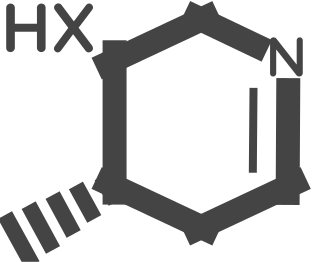 Structure

 P&D probe-likeness score

Structure formats
[[ format ]]
[[ compound[format === 'MOL' ? 'molblock' : format.toLowerCase()] ]]
Description
(extracted from source data)
PHARMACODYNAMICS
It acts by relaxing smooth muscle in the bronchial tubes to increase air flow and relieve acute shortness of breath.
MOA
β2 adrenergic receptors on airway smooth muscle are Gs coupled and their activation by levosalbutamol leads to activation of adenylate cyclase and to an increase in the intracellular concentration of 3',5'-cyclic adenosine monophosphate (cyclic AMP). Increased cyclic AMP activates protein kinase A which itself inhibits the phosphorylation of myosin produces lower intracellular ionic calcium concentrations, inducing muscle relaxation. Increased cyclic AMP concentrations are also associated with the inhibition of the release of mediators from mast cells in the airways, potentially contributing to its benefit in asthma attacks.
INDICATION
Indicated for the management of COPD (chronic obstructive pulmonary disease, also known as chronic obstructive lung disease) and asthma.
DESCRIPTION
Levosalbutamol is a short-acting β2-adrenoceptor agonist used in anti-asthma medications. Structurally it is the R enantiomer of the racemic mixture that has the INN . Levosalbutamol belongs to the 'short-acting beta-agonist' (SABA) drug family.
(GtoPdb)
PRICE
68
DESCRIPTION
Levalbuterol tartrate is a short-acting ??2-adrenergic receptor agonist and the R enantiomer of salbutamol.
DESCRIPTION
Levalbuterol is a short-acting beta 2 adrenergic agonist. Levalbuterol binds to beta 2 adrenergic receptors and activates intracellular adenyl cyclase to promote the convertion of adenosine triphosphate (ATP) to cyclic-3',5'-adenosine monophosphate (cAMP). It is used to treat wheezing and shortness of breath caused by breathing problems (such as asthma, chronic obstructive pulmonary disease).
(BOC Sciences Bioactive Compounds)
DESCRIPTION
Levalbuterol tartrate is a short-acting β2-adrenergic receptor agonist and the R enantiomer of salbutamol.
(TargetMol Bioactive Compound Library)
DESCRIPTION
R-Salbutamol sulphate is a short-acting beta2-adrenergic receptor agonist. It has the potential for the treatment of COPD.
(Enamine Bioactive Compounds)
[[ p.pathway_name ]]
[[ compound.targets[tid].gene_name ]]

Compound Sets
22
BOC Sciences Bioactive Compounds
Cayman Chemical Bioactives
ChEMBL Approved Drugs
ChEMBL Drugs
Drug Repurposing Hub
DrugBank
DrugBank Approved Drugs
DrugCentral
DrugCentral Approved Drugs
DrugMAP
DrugMAP Approved Drugs
Enamine Bioactive Compounds
Enamine BioReference Compounds
Guide to Pharmacology
LSP-MoA library (Laboratory of Systems Pharmacology)
MedChem Express Bioactive Compound Library
NCATS Inxight Approved Drugs
Other bioactive compounds
Prestwick Chemical Library
ReFrame library
Selleckchem Bioactive Compound Library
TargetMol Bioactive Compound Library
[[ a.name ]]
[[ ligand_id ]]
free of charge
External IDs
96

Molecular Weight
239.15
Hydrogen Bond Acceptors
4
Hydrogen Bond Donors
4
Rotatable Bonds
4
Ring Count
1
Aromatic Ring Count
1
cLogP
1.31
TPSA
72.72
Fraction CSP3
0.54
Chiral centers
1.0
Largest ring
6.0
QED
0.64

Structural alerts
0
No structural alerts detected

Related compounds
Custom attributes
(extracted from source data)
Pathway
Neuronal Signaling
GPCR/G protein
Neuroscience
Target
Adrenergic Receptor
β2-adrenergic receptor
ADRB2
Indication
bronchospasm
MOA
Adrenergic Receptor agonist
Source data