
General
Preferred name
Xylose
Synonyms
(¡À)-Xylos ()
D(+)-Xylose ()
(+)-Xylose ()
Wood sugar ()
(±)-Xylos ()
(±)-Xylose ()
(¡À)-Xylose ()
(??)-Xylos ()
Hexadecylphosphocholine(¡À)-Xylose ()
DL-Xylose ()
D-(+)-Xylose ()
D-xylose ()
Xylo-Pfan ()
FEMA NO. 3606 ()
NSC-122762 ()
Xylose ()
P&D ID
PD010855
CAS
25990-60-7
58-86-6
Tags
available
drug
Drug Status
approved
Max Phase
4.0
First approval
1982

Probe control
Probe control not defined

Orthogonal probes
0
No orthogonal probes found

Similar probes
0
No structurally similar probes found
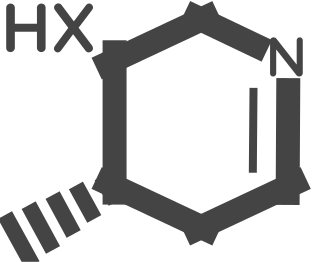 Structure

 P&D probe-likeness score

Structure formats
[[ format ]]
[[ compound[format === 'MOL' ? 'molblock' : format.toLowerCase()] ]]
Description
(extracted from source data)
TOXICITY
Although many national health agencies like the FDA and Health Canada have concluded that the addition or use of food additive sweeteners like xylose is safe and effective for their intended purposes of use in food, it is also known that eating too much of these substances can also ultimately cause gastrointestinal discomfort and laxative effects [L2428]. These effects are largely the result of excessive amounts of ingested sugar alcohols being poorly taken up from the gastrointestinal tract [L2428]. Regardless, the extent to which these kinds of effects occur depends on variances between individuals and it is also possible for individuals to develop a tolerance via frequent consumption of such sweetener containing products [L2428]. In doing so, such individuals can increase consumption of these agents without experiencing adverse effects [L2428].; ; The acute oral toxicity (LD50) for the mouse animal model has been recorded as 23000 mg/kg [MSDS].
ABSORPTION
When 12 normal healthy subjects were given an intravenous D-xylose dosing of 10 grams and then an oral dose of 25 grams a week later, the observed absorption percentage was about 69.4% (p < 0.002) and the observed absorption rate was approximately 1.03/hr (p< 0.05) [A32672].; ; The maximum concentration observed in the subjects was 0.53 mg/L with 71 minutes being the time to reach the maximum concentration [T171]. The absolute bioavailability recorded was 69% [T171].
INDICATION
The predominant everyday nutritional usage of xylose is as a parent sugar alcohol from which another sugar alcohol - xylitol- can be derived from and used as an extremely common food additive or sweetener to be used in place of regular sugars as a lower calorie alternative [L2428, L2429, A32661].; ; Alternatively, xylose was also involved in a procedure known as a D-xylose absorption test that used to be employed to evaluate how well an individual was capable of absorbing a simple sugar like D-xylose from the intestines [L2432]. By measuring the amount of D-xylose in urine and blood samples after an individual ingested a certain amount of the simple sugar dissolved in some water, the test sought to determine if nutrients were being properly absorbed in the patient's gastrointestinal tract [L2432].
DESCRIPTION
Xylose (D-(+)-Xylose) is a natural pentose sugar that is catalyzed by xylose isomerase to form xylulose, which is a key step in the anaerobic ethanol fermentation of Xylose. Xylose can be used by microorganisms to produce fuels, chemicals, and bulk industrial enzymes. Xylose provides the substances and energy for cells, as a carbon source for the biosynthesis of high-value chemicals and biofuel. Xylose can be used to fully explore lignocellulose resources and provide a new direction for microbia fermentation[1][2][3][4].
PRICE
29
DESCRIPTION
DL-Xylose ((??)-Xylos) is a sugar first derived from wood. DL-Xylose is classified as a monosaccharide of the aldopentose type.
DESCRIPTION
Xylose is a monosaccharide of the aldopentose type consisted of five carbon atoms and an aldehyde functional group. It is isolated from wood. Xylose is a sugar widely used as a diabetic sweetener in food and beverage. It has also been used as a diagnostic agent to observe malabsorption.
(Enamine Bioactive Compounds)
DESCRIPTION
D-(+)-Xylose (Wood sugar) is an aldopentose - a monosaccharide containing five carbon atoms and an aldehyde functional group. It has chemical formula C5H10O5 and is 40% as sweet as sucrose. Xylose is also found in mucopolysaccharides of connective tissue and sometimes in the urine. Xylose is the first sugar added to serine or threonine residues during proteoglycan type O-glycosylation. Therefore xylose is involved in the biosythetic pathways of most anionic polysaccharides such as heparan sulphate and chondroitin sulphate. In medicine, xylose is used to test for malabsorption by administering a xylose solution to the patient after fasting. If xylose is detected in the blood and/or urine within the next few hours, it has been absorbed by the intestines. Xylose is said to be one of eight sugars which are essential for human nutrition, the others being galactose, glucose, mannose, N-acetylglucosamine, N-acetylgalactosamine, fucose, and sialic acid. . Xylose in the urine is a biomarker for the consumption of apples and other fruits.
(TargetMol Bioactive Compound Library)
DESCRIPTION
DL-Xylose ((±)-Xylos) is a sugar first derived from wood. DL-Xylose is classified as a monosaccharide of the aldopentose type.
(TargetMol Bioactive Compound Library)
[[ p.pathway_name ]]
[[ compound.targets[tid].gene_name ]]

Compound Sets
16
Cayman Chemical Bioactives
ChEMBL Approved Drugs
ChEMBL Drugs
Concise Guide to Pharmacology 2017/18
Concise Guide to Pharmacology 2019/20
Concise Guide to Pharmacology 2021/22
Concise Guide to Pharmacology 2023/24
Drug Repurposing Hub
DrugBank
DrugBank Approved Drugs
Enamine Bioactive Compounds
Guide to Pharmacology
Selleckchem Bioactive Compound Library
The Spectrum Collection
[[ a.name ]]
[[ ligand_id ]]
free of charge
External IDs
34

Molecular Weight
150.05
Hydrogen Bond Acceptors
5
Hydrogen Bond Donors
4
Rotatable Bonds
4
Ring Count
0
Aromatic Ring Count
0
cLogP
-2.74
TPSA
97.99
Fraction CSP3
0.8
Chiral centers
3.0
Largest ring
0.0
QED
0.33

Structural alerts
0
No structural alerts detected

Related compounds
Custom attributes
(extracted from source data)
Target
Endogenous Metabolite
Drug intermediate
Pathway
Metabolism
Metabolic Enzyme/Protease
Source data