
General
Preferred name
LUTEOLIN
Synonyms
ML061 Analog ()
Digitoflavone ()
B-Lactams ()
Flavonoid derivative 1 ()
Luteolin (monohydrate) ()
Luteoline ()
Luteolol ()
Luteoline, Luteolol, Digitoflavone ()
2-(3,4-dihydroxyphenyl)-5,7-dihydroxy-4H-chromen-4-one ()
Salifazide ()
Yama kariyasu ()
Cyanidenon-1470 ()
Weld lake ()
Flacitran ()
P&D ID
PD010790
CAS
491-70-3
6113-16-2
Tags
available
nuisance
obsolete probe
probe
drug
natural product
Drug indication
Bacterial infection
Drug Status
approved
experimental
investigational
Max Phase
2.0

Probe info
Probe type
calculated probe
Probe selectivity
protein-selective
Probe sources
Probe targets
[[ compound.targets[t].gene_name ]]

Probe control
Probe control not defined

Orthogonal probes
1
No orthogonal probes found

Similar probes
1
No structurally similar probes found
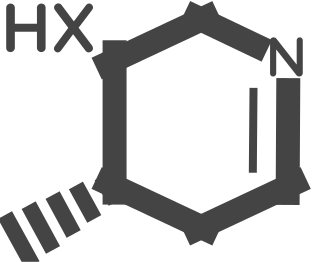 Structure

 P&D probe-likeness score

Structure formats
[[ format ]]
[[ compound[format === 'MOL' ? 'molblock' : format.toLowerCase()] ]]
Description
(extracted from source data)
DESCRIPTION
Luteolin is a flavone, a type of flavonoid, naturally occuring in a variety of plants, including Resedaceae luteola (dyer's rocket). Reported pharmacological activities include anti-inflammatory, antiallergic, antimicrobial, and antiviral effects. It has antimalarial activity, inhibiting the growth of P. falciparum during the intraerythrocytic stages of the parasite's lifecycle . Directly binding to PPARγ (binding affinity ~10 μm) has also been proposed as a mechanism through which the compound may provide benefit in Alzheimer's disease models .
(GtoPdb)
DESCRIPTION
Luteolin (Luteoline), a flavanoid compound, is a potent Nrf2 inhibitor. Luteolin has anti-inflammatory, anti-cancer properties, including the induction of apoptosis and cell cycle arrest, and the inhibition of metastasis and angiogenesis, in several cancer cell lines, including human non-small lung cancer cells[1][2][3].
PRICE
32
DESCRIPTION
Luteolin (Luteolol) belongs to the flavonoid group of natural products and is a Nrf2 inhibitor, PDE inhibitor. Luteolin has a wide range of biological activities including antitumor, antioxidant, anti-inflammatory, antimicrobial, antiviral, antiallergic, and procoagulant.
DESCRIPTION
Luteolin (monohydrate) is the monohydrate of Luteolin. Luteolin (Luteoline), a flavonoid, is also a potent Nrf2 inhibitor. Luteolin has anti-inflammatory and anticancer properties, induces apoptosis and cell cycle arrest in multiple human cancer cell lines, including non-small lung cancer cells, and inhibits cell metastasis and angiogenesis[1].
DESCRIPTION
5-HT and NA reuptake inhibitor (SNRI)
(Tocris Bioactive Compound Library)
DESCRIPTION
Luteolin is a polyphenolic flavone found in many plants including soybeans and perilla leaves. It inhibits Aurora B kinase activity (Kd=5.851 pM) and blocks proliferation of cancer cells.
(Enamine Bioactive Compounds)
DESCRIPTION
Activity at soybean LOX-1 using linoleic acid as substrate at 50 uM preincubated for 5 mins followed by substrate addition by Michaelis-Menten plot analysis; Inhibition of human recombinant carbonic anhydrase 7 preincubated for 15 mins at room temperature/6 hrs at 4 deg C by stopped-flow CO2 hydration assay
(TargetMol Bioactive Compound Library)
[[ p.pathway_name ]]
[[ compound.targets[tid].gene_name ]]

Cell lines
21

Organisms
9
Compound Sets
23
A Collection of Useful Nuisance Compounds (CONS) for Interrogation of Bioassay Integrity
AdooQ Bioactive Compound Library
Cayman Chemical Bioactives
ChEMBL Drugs
Concise Guide to Pharmacology 2023/24
CZ-OPENSCREEN Bioactive Library
Drug Repurposing Hub
DrugBank
DrugMAP Approved Drugs
Enamine Bioactive Compounds
Guide to Pharmacology
IPPI - DB
MedChem Express Bioactive Compound Library
MLSMR Probes +
Nuisance compounds in cellular assays
Obsolete Compounds
Prestwick Chemical Library
Probe Miner (suitable probes)
ReFrame library
Selleckchem Bioactive Compound Library
TargetMol Bioactive Compound Library
Tocris Bioactive Compound Library
[[ a.name ]]
[[ ligand_id ]]
free of charge
External IDs
48

Molecular Weight
286.05
Hydrogen Bond Acceptors
6
Hydrogen Bond Donors
4
Rotatable Bonds
1
Ring Count
3
Aromatic Ring Count
3
cLogP
2.28
TPSA
111.13
Fraction CSP3
0.0
Chiral centers
0.0
Largest ring
6.0
QED
0.51

Structural alerts
5
aggregator (Aggregator Advisor)
Aggregators
historic compounds (Chemical Probes.org)
Obsolete
aggregator (ZINC)
Aggregators
Nonspecific reactivity
Nuisance compounds
Nonspecific/NOS
Flavonoid
Nuisance compounds

Related compounds
Custom attributes
(extracted from source data)
Classification
probe analog
Primary Target
Antioxidants
Target
TOP1
Apoptosis
Autophagy
Endogenous Metabolite
Keap1-Nrf2
ADC Cytotoxin,PDE
MOA
glucosidase inhibitor
Pathway
Metabolic Enzyme/Protease
NF-κB
NF-¦ÊB
Nuisance MOA
catechol
Targets
Carbonic anhydrase VII
Cytochrome P450 1B1
Carbonic anhydrase XII
Source data