
General
Preferred name
ANAGRELIDE
Synonyms
ANAGRELIDE HYDROCHLORIDE ()
BMY 26538-01 ()
Anagrelide HCl ()
Agrylin ()
BL4162A ()
Anagrelide (hydrochloride) ()
BL-4162A,BMY 26538-01 ()
Anagrelide (hydrochloride) ()
BL-4162a ()
Xagrid ()
NSC-724577 ()
NSC-759170 ()
Anagrelide hydrochloride monohydrate ()
Anagrelide mylan ()
Anagrelide viatris (previously anagrelide mylan) ()
BMY-26538-01 ()
Thromboreductin ()
Anagrelide hydrochloride hydrate ()
Agrelin ()
Anagrelida ()
Anagrelide-13C3 ()
P&D ID
PD010137
CAS
68475-42-3
58579-51-4
Tags
available
drug
Approved by
FDA
EMA
First approval
1997
Drug indication
Essential thrombocythemia
Thrombocythemia
Drug Status
approved
Max Phase
4.0

Probe control
Probe control not defined

Orthogonal probes
0
No orthogonal probes found

Similar probes
0
No structurally similar probes found
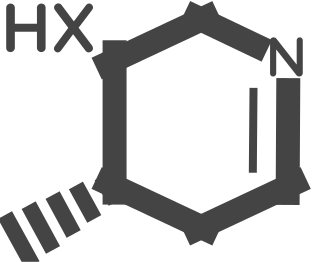 Structure

 P&D probe-likeness score

Structure formats
[[ format ]]
[[ compound[format === 'MOL' ? 'molblock' : format.toLowerCase()] ]]
Description
(extracted from source data)
DESCRIPTION
Anagrelide hydrochloride (BL4162A) is a potent inhibitor of phosphodiesterase type III (PDE3) (IC50=36?nM). Anagrelide hydrochloride, an imidazoquinazoline derivative, acts as an inhibitor of platelet aggregation. Anagrelide hydrochloride inhibits bone marrow megakaryocytopoiesis. Anagrelide hydrochloride decreases gastrointestinal stromal tumor (GIST) cell proliferation and promotes their apoptosis in vitro. Anagrelide hydrochloride is a platelet-lowering agent and plays in the antithrombopoietic action[1][2][3].
PRICE
36
PHARMACODYNAMICS
Anagrelide is a drug used for the treatment of essential thrombocytosis (ET; essential thrombocythemia). It works by inhibiting the maturation of megakaryocytes into platelets. Although its exact mechanism of action is not fully understood, it is proposed to primarily work by inhibiting the phosphodiesterase-III enzyme.
DESCRIPTION
Anagrelide is a phosphodiesterase inhibitor with antiplatelet activity .
(GtoPdb)
DESCRIPTION
Anagrelide is a potent inhibitor of phosphodiesterase type III (PDE3) (IC50=36?nM). Anagrelide, an imidazoquinazoline derivative, acts as an inhibitor of platelet aggregation. Anagrelide inhibits bone marrow megakaryocytopoiesis. Anagrelide decreases gastrointestinal stromal tumor (GIST) cell proliferation and promotes their apoptosis in vitro. Anagrelide is a platelet-lowering agent and plays in the antithrombopoietic action[1][2][3].
PRICE
48
DESCRIPTION
Anagrelide (Xagrid) is a Platelet-reducing Agent. The mechanism of action of anagrelide is as a Phosphodiesterase 3 Inhibitor. The physiologic effect of anagrelide is by means of Decreased Platelet Production.
DESCRIPTION
Anagrelide is a drug used for the treatment of essential thrombocytosis,or overproduction of blood platelets. It also has been used in the treatment of chronic myeloid leukemia.
(BOC Sciences Bioactive Compounds)
DESCRIPTION
Anagrelide is a platelet-reducing agent. It is an inhibitor of phosphodiesterase 3A. Anagrelide is indicated for the treatment of thrombocythemia, secondary to malignant neoplasms, to reduce platelet count and the associated risk of thrombosis.
(Enamine Bioactive Compounds)
DESCRIPTION
Anagrelide hydrochloride (BL4162A) serves as a treatment for essential thrombocytosis.
(TargetMol Bioactive Compound Library)
DESCRIPTION
Anagrelide is a phosphodiesterase inhibitor with antiplatelet activity with IC50 value of 36 nM for inhibition of phosphodiesterase 3. It inhibits the maturation of megakaryocytes into platelets, reducing both megakaryocyte hyperproliferation and differentiation. It is antithrombocythemic used for the treatment of overproduction of blood platelets. It is a synthetic quinazoline derivative and is used as is a platelet-reducing agent. It reduces platelet production through a decrease in megakaryocyte maturation. It inhibits cyclic AMP phosphodiesterase, as well as ADP- and collagen-induced platelet aggregation. It is a drug used for the treatment of essential thrombocytosis or overproduction of blood platelets. It also has been used in the treatment of chronic myeloid leukemia. It was developed by Shire and has been listed.
(BOC Sciences Bioactive Compounds)
[[ p.pathway_name ]]
[[ compound.targets[tid].gene_name ]]

Cell lines
1

Organisms
3

Compound Sets
32
BOC Sciences Bioactive Compounds
ChEMBL Approved Drugs
ChEMBL Drugs
Concise Guide to Pharmacology 2017/18
Concise Guide to Pharmacology 2019/20
Concise Guide to Pharmacology 2021/22
CZ-OPENSCREEN Bioactive Library
Drug Repurposing Hub
DrugBank
DrugBank Approved Drugs
DrugCentral
DrugCentral Approved Drugs
DrugMAP
DrugMAP Approved Drugs
DrugMatrix
Enamine Bioactive Compounds
Enamine BioReference Compounds
EU-OPENSCREEN Bioactive Compound Library
Guide to Pharmacology
LSP-MoA library (Laboratory of Systems Pharmacology)
Mcule NIBR MoA Box Subset
NCATS Inxight Approved Drugs
NIH Clinical Collections (NCC)
Novartis Chemogenetic Library (NIBR MoA Box)
NPC Screening Collection
Prestwick Chemical Library
ReFrame library
Selleckchem Bioactive Compound Library
TargetMol Bioactive Compound Library
The Spectrum Collection
[[ a.name ]]
[[ ligand_id ]]
free of charge
External IDs
71

Molecular Weight
255.0
Hydrogen Bond Acceptors
3
Hydrogen Bond Donors
1
Rotatable Bonds
0
Ring Count
3
Aromatic Ring Count
1
cLogP
1.93
TPSA
44.7
Fraction CSP3
0.2
Chiral centers
0.0
Largest ring
6.0
QED
0.77

Structural alerts
0
No structural alerts detected

Related compounds
Custom attributes
(extracted from source data)
Target
PDE
phosphodiesterase
PDE3A
Apoptosis
Phosphodiesterase (PDE)
Member status
member
MOA
PDE3A inhibitor
phosphodiesterase inhibitor
Disease Area
hematology, hematologic malignancy
Indication
thrombocythemia, myeloproliferative neoplasms
Pathway
Metabolism
Metabolic Enzyme/Protease
Therapeutic Class
Antithrombotic Agents
Solubility
Soluble in DMSO, not in water
Source data