
General
Preferred name
EPINEPHRINE
Synonyms
(-)-Epinephrine bitartrate ()
(-)-Adrenalin ()
(-)-Epinephrine (+)-bitartrate salt ()
L-Adrenaline (+)-bitartrate salt ()
Adrenaline hydrochloride ()
EPINEPHRINE BITARTRATE ()
L-Adrenaline (+)-bitartrate salt(-)-Epinephrine (+)-bitartrate salt ()
L-Epinephrine Bitartrate ()
(-)-Adrenalin(-)-Epinephrine ()
(?)-Epinephrine ()
Adrenalinium ()
Adrenaline ()
EPINEPHRINE HYDROCHLORIDE ()
Epinephrine HCl ()
(-)-Epinephrine ()
(-)-adrenaline ()
SUSPHRINE ()
EPPY ()
ADRENALINUM ()
ADRENACLICK ()
RYBARVIN ()
RACEPINEFRINE, (R)- ()
TONOGEN ()
NEPHRIDINE ()
EPI E Z PEN JR ()
EPIPEN JR. ()
PRIMATENE MIST ()
RIDDOFAN ()
JEXT ()
NSC-62786 ()
AUVI-Q ()
EMERADE ()
EPIPEN ()
Epinephrine component of duranest ()
EPIPEN JR ()
GLAUPOSINE ()
SUS-PHRINE SULPHITE-FREE ()
L-EPINEPHRINE HYDROCHLORIDE ()
TWINJECT ()
ANAPEN ()
ASMA-VYDRIN ()
ADRENALIN ()
BRONKAID MIST ()
EPIPEN E Z PEN ()
GPPE INH SOLN ()
TWINJECT 0.15 ()
RACEPINEFRINE HYDROCHLORIDE, (R)- ()
RIDDOBRON ()
SYMJEPI ()
BROVON ()
Epinephrine component of octocaine ()
TWINJECT 0.3 ()
SUS-PHRINE SULFITE FREE ()
EPINEPHRINUM ()
Sus-phrine sulfite-free ()
ANAPHYLACTIC SHOCK DRUG KIT ()
Epinephrine component of lidosite topical system kit ()
ADREN CO ()
EPINEPHRINE (COPACKAGED) ()
ANA-GUARD ()
Neffy ()
PRIMATENE ()
Sus-Phrine ()
Ana-Kit ()
Epinephrine component of iontocaine ()
ASTHMAHALER ()
(-)-(R)-EPINEPHRINE ()
EPINEFRINA ()
SIMPLENE ()
SOLN MADE TO RYBARVIN FOR ()
Epinephrine tartrate ()
Epinephrine bitartrate component of sensorcaine ()
Epinephrine bitartrate component of septocaine ()
Epinephrine bitartrate component of duranest ()
Epinephrine hydrogen tartrate ()
Epinephrine bitartrate component of lignospan forte ()
Adrenaline (as tartrate) ()
NSC-756755 ()
Adrenalin tartrate ()
Epinephrini hydrogenotartras ()
Bronitin Mist ()
(-)-Epinephrine Bitartrate ()
Adrenaline acid tartrate ()
Adrenaline bitartate ()
Epinephrine bitartrate component of orabloc ()
Epinephrine d-bitartrate ()
MEDIHALER-EPI ()
Bronitin ()
L-epinephrine hydrogen tartrate ()
EPINEPHRINE COMPONENT OF DURANEST ()
EPINEPHRINE COMPONENT OF IONTOCAINE ()
EPINEPHRINE COMPONENT OF LIDOSITE TOPICAL SYSTEM KIT ()
EPINEPHRINE COMPONENT OF OCTOCAINE ()
NEFFY ()
P&D ID
PD009858
CAS
51-42-3
16536-89-3
55-31-2
39836-34-5
104655-05-2
51-43-4
Tags
available
drug
Approved by
FDA
First approval
1948
1965
Drug indication
Allergy
Pain
Nasal congestion
Drug Status
vet_approved
approved
Max Phase
4.0

Probe control
Probe control not defined

Orthogonal probes
0
No orthogonal probes found

Similar probes
0
No structurally similar probes found
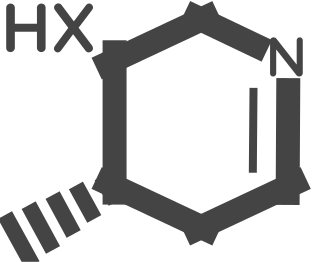 Structure

 P&D probe-likeness score

Structure formats
[[ format ]]
[[ compound[format === 'MOL' ? 'molblock' : format.toLowerCase()] ]]
Description
(extracted from source data)
ROE
The majority of the dose of epinephrine is seen excreted in the urine [L4361], [FDA label].; About 40% of a parenteral dose of epinephrine is excreted in urine as metanephrine, 40% as VMA, 7% as 3-methoxy-4-hydroxyphenoglycol, 2% as 3,4-dihydroxymandelic acid, and the rest as acetylated derivatives. These metabolites are excreted mainly as the sulfate conjugates and, to a lesser extent, the glucuronide conjugates. Only small amounts of the drug are excreted completely unchanged [L4827].
DESCRIPTION
Agonist at alpha and beta adrenoceptors. In addition to being assigned the INN epinephrine in its own right, (-)-adrenaline is also one of the enantiomers found in the INN-assigned compound .
(GtoPdb)
PHARMACODYNAMICS
Epinephrine is a sympathomimetic drug. It causes an adrenergic receptive mechanism on effector cells and mimics all actions of the sympathetic nervous system except those on the facial arteries and sweat glands [F1247]. ; ; Important effects of epinephrine include increased heart rate, myocardial contractility, and renin release via beta-1 receptors. Beta-2 effects produce bronchodilation which may be useful as an adjunct treatment of asthma exacerbations as well as vasodilation, tocolysis, and increased aqueous humor production [L4825]. In croup, nebulized epinephrine is associated with both clinically and statistically significant transient reduction of croup symptoms 30 minutes post-treatment [A40032]. Epinephrine also alleviates pruritus, urticaria, and angioedema and may be helpful in relieving gastrointestinal and genitourinary symptoms associated with anaphylaxis because of its relaxing effects on the smooth muscle of the stomach, intestine, uterus, and urinary bladder [FDA label].
INDICATION
Epinephrine injection is indicated in the emergency treatment of allergic reactions (Type I) including anaphylaxis to stinging insects (e.g., order Hymenoptera, which include bees, wasps, hornets, yellow jackets and fire ants) and biting insects (e.g., triatoma, mosquitos), allergen immunotherapy, foods, drugs, diagnostic testing substances (e.g., radiocontrast media) and other allergens, as well as idiopathic anaphylaxis or exercise-induced anaphylaxis. Injectable epinephrine is intended for immediate/urgent administration in patients, who are found to be at increased risk for anaphylaxis, including individuals with a history of anaphylaxis. Selection of the appropriate dosage strength is determined according to body weight [FDA label]. ; ; Epinephrine's cardiac effects may be of use in restoring cardiac rhythm in cardiac arrest due to various causes but is not used in cardiac failure or in hemorrhagic, traumatic, or cardiogenic shock [F1247].; ; Epinephrine is used as a hemostatic agent. It is also used in treating mucosal congestion of hay fever, rhinitis, and acute sinusitis; to relieve bronchial asthmatic paroxysms; in syncope due to complete heart block or carotid sinus hypersensitivity; for symptomatic relief of serum sickness, urticaria, angioneurotic edema; for resuscitation in cardiac arrest following anesthetic accidents; in simple (open angle) glaucoma; for relaxation of uterine musculature and to inhibit uterine contractions. Epinephrine injection can be utilized to prolong the action of local anesthetics [F1247].; ; In addition to the above, epinephrine is used as an over the counter (OTC) agent for the intermittent symptoms of asthma, such as wheezing, tightness of chest and shortness of breath [F2131]. It is also used for the maintenance of mydriasis during intraocular surgery [L4825].
DESCRIPTION
Epinephrine is a hormone and neurotransmitter and produced by the adrenal glands that can also be used as a drug due to its various important functions. Epinephrine is used to treat allergic reactions, to restore cardiac rhythm, and to control mucosal congestion, glaucoma, and asthma.
(Enamine Bioactive Compounds)
DESCRIPTION
Epinephrine HCl is a hormone and a neurotransmitter. As a medication it is used for a number of conditions including: anaphylaxis, cardiac arrest, and superficial bleeding.
(BOC Sciences Bioactive Compounds)
DESCRIPTION
Endogenous hormone and neurotransmitter
(LOPAC library)
[[ p.pathway_name ]]
[[ compound.targets[tid].gene_name ]]

Cell lines
0

Organisms
2

Compound Sets
29
BOC Sciences Bioactive Compounds
Cayman Chemical Bioactives
CeMM library of unique drugs (CLOUD)
ChEMBL Approved Drugs
ChEMBL Drugs
Concise Guide to Pharmacology 2017/18
Concise Guide to Pharmacology 2019/20
Concise Guide to Pharmacology 2021/22
Concise Guide to Pharmacology 2023/24
Drug Repurposing Hub
DrugBank
DrugBank Approved Drugs
DrugCentral
DrugCentral Approved Drugs
DrugMAP
DrugMAP Approved Drugs
Enamine Bioactive Compounds
Enamine BioReference Compounds
EUbOPEN Chemogenomics Library
Guide to Pharmacology
LOPAC library
LSP-MoA library (Laboratory of Systems Pharmacology)
Mcule NIBR MoA Box Subset
NCATS Inxight Approved Drugs
Novartis Chemogenetic Library (NIBR MoA Box)
NPC Screening Collection
Other bioactive compounds
ReFrame library
Selleckchem Bioactive Compound Library
[[ a.name ]]
[[ ligand_id ]]
free of charge
External IDs
112

Molecular Weight
183.09
Hydrogen Bond Acceptors
4
Hydrogen Bond Donors
4
Rotatable Bonds
3
Ring Count
1
Aromatic Ring Count
1
cLogP
0.35
TPSA
72.72
Fraction CSP3
0.33
Chiral centers
1.0
Largest ring
6.0
QED
0.51

Structural alerts
0
No structural alerts detected

Related compounds
Custom attributes
(extracted from source data)
Target
Endogenous Metabolite
Adrenergic Receptor
TNF-¦Á
PAH
ADRA1A, ADRA1B, ADRA1D, ADRA2A, ADRA2B, ADRA2C, ADRB1, ADRB2, ADRB3, PAH, TNF
Pathway
Metabolic Enzyme/Protease
Neuronal Signaling
Neuroscience
GPCR/G protein
Apoptosis
MOA
Adrenergic Receptor agonist
Adrenergic Receptor inhibitor
TNF
TNF antagonist
Adrenergic Agonists
adrenergic receptor agonist, carbonic anhydrase activator, neurotransmitter
Member status
member
Indication
cardiac arrest, anaphylactic shock, asthma
Disease Area
cardiology, allergy, pulmonary
Therapeutic Class
Vasoconstrictor Agents
Recommended Cell Concentration
None
Source data