
General
Preferred name
pergolide
Synonyms
PERGOLIDE MESYLATE ()
Pergolide methanesulfonate ()
CPD000058504 ()
LY127809 ()
Pergolide mesylate salt ()
Permax ()
Pergolide (mesylate) ()
LY 127809 ()
Pergolide mesilate ()
NSC-758442 ()
NSC-319773 ()
LY-127809 ()
Celance ()
Pergolida ()
P&D ID
PD009755
CAS
66104-23-2
66104-22-1
Tags
available
drug
biased GPCR ligand
Approved by
FDA
First approval
1988
Drug indication
cocaine dependence
Parkinson disease
Drug Status
vet_approved
approved
withdrawn
investigational
Max Phase
4.0

Probe control
Probe control not defined

Orthogonal probes
0
No orthogonal probes found

Similar probes
0
No structurally similar probes found
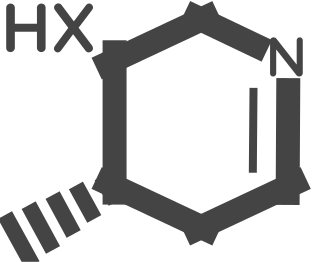 Structure

 P&D probe-likeness score

Structure formats
[[ format ]]
[[ compound[format === 'MOL' ? 'molblock' : format.toLowerCase()] ]]
Description
(extracted from source data)
DESCRIPTION
Pergolide mesylate (Pergolide methanesulfonate), an Ergoline derivative, is a potent and orally active dopamine D1 and D2 receptors agonist. Pergolide mesylate can be used for Parkinson's disease and hyperprolactinaemia research[1][2].
PRICE
59
DESCRIPTION
Dopamine receptor agonist; antiparkinsonian
(LOPAC library)
DESCRIPTION
Pergolide Mesylate is an antiparkinsonian agent which functions as a dopaminergic agonist.
(BOC Sciences Bioactive Compounds)
DESCRIPTION
Pergolide mesylate salt(LY127809) is a long-acting dopamine agonist which has been used to treat PARKINSON DISEASE and HYPERPROLACTINEMIA but withdrawn from some markets due to potential for HEART VALVE DISEASES.
(TargetMol Bioactive Compound Library)
DESCRIPTION
Pergolide (Permax, Pergotoliderived) is an ergoline-based dopamine receptor agonist used in some countries for the treatment of Parkinson's disease. Parkinson's disease is associated with low levels of the neurotransmitter dopamine in the brain. Pergolide has some of the same effects as dopamine in the body. In 2007, pergolide was withdrawn from the U.S. market after several published studies revealed a link between the drug and increased rates of valvular dysfunction.
(BOC Sciences Bioactive Compounds)
[[ p.pathway_name ]]
[[ compound.targets[tid].gene_name ]]
Cell lines
0

Organisms
2

Compound Sets
27
AdooQ Bioactive Compound Library
BiasDB
Bioprocess diversity set
BOC Sciences Bioactive Compounds
Cayman Chemical Bioactives
ChEMBL Approved Drugs
ChEMBL Drugs
Drug Repurposing Hub
DrugBank
DrugBank Approved Drugs
DrugCentral
DrugCentral Approved Drugs
DrugMAP
DrugMAP Approved Drugs
EU-OPENSCREEN Bioactive Compound Library
Guide to Pharmacology
LOPAC library
LSP-MoA library (Laboratory of Systems Pharmacology)
MedChem Express Bioactive Compound Library
Natural product-based probes and drugs
NIH Clinical Collections (NCC)
NPC Screening Collection
Prestwick Chemical Library
ReFrame library
Selleckchem Bioactive Compound Library
TargetMol Bioactive Compound Library
Withdrawn 2.0
[[ a.name ]]
[[ ligand_id ]]
free of charge
External IDs
69

Molecular Weight
314.18
Hydrogen Bond Acceptors
2
Hydrogen Bond Donors
1
Rotatable Bonds
4
Ring Count
4
Aromatic Ring Count
2
cLogP
4.27
TPSA
19.03
Fraction CSP3
0.58
Chiral centers
3.0
Largest ring
6.0
QED
0.91

Structural alerts
0
No structural alerts detected

Related compounds
Custom attributes
(extracted from source data)
Selectivity
D2/D1
Biological process
rRNA & ncRNA processing
Target
5-HT Receptor
Adrenergic Receptor
dopamine
ADRA1A, ADRA1B, ADRA1D, ADRA2A, ADRA2B, ADRA2C, DRD1, DRD2, DRD3, DRD4, DRD5, HTR1A, HTR1B, HTR1D, HTR2A, HTR2B, HTR2C
Dopamine Receptor
MOA
Dopamine Receptor agonist
ATC
N04BC02
Toxicity type
cardiovascular
Biosynthetic Origin
Alkaloid
Therapeutic Indication
Alzheimer's Disease
Therapeutic Class
CNS & PNS
Antiparkinson Agents
Pathway
GPCR/G protein
Neuroscience
Neuronal Signaling
Source data