
General
Preferred name
OXYBUTYNIN
Synonyms
OXYBUTYNIN CHLORIDE ()
Oxybutinin ()
Oxytrol ()
Ditropan ()
Oxibutyninum ()
Oxybutynin hydrochloride ()
Oxybutynin HCl ()
Oxybutynine ()
Oxybutynin (chloride) ()
MJ4309-1 ()
MJ 4309-1 ()
Ditropan XL ()
Gelnique ()
5058 ()
Pollakisu ()
MJ-4309-1 ()
NSC-759108 ()
Tropax ()
Promictuline ()
Cystrin ()
Kentera ()
Contimin 5 ()
Lyrinel XL ()
Oxytrol For Women ()
Urimin ()
Kentera (previously oxybutynin nicobrand) ()
Contimin 2.5 ()
Oxibutinina ()
Oxybutynin (hydrochloride) ()
Oxybutynin-d10 (hydrochloride) ()
P&D ID
PD009572
CAS
5633-20-5
119579-36-1
1508-65-2
120092-65-1
Tags
available
drug
Approved by
PMDA
FDA
First approval
1975
Drug indication
Neurogenic bladder
Overactive bladder
Urinary incontinence
Discovery agent
Drug Status
approved
investigational
Max Phase
4.0

Probe control
Probe control not defined

Orthogonal probes
0
No orthogonal probes found

Similar probes
0
No structurally similar probes found
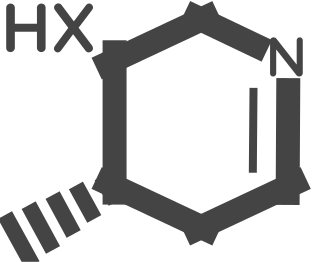 Structure

 P&D probe-likeness score

Structure formats
[[ format ]]
[[ compound[format === 'MOL' ? 'molblock' : format.toLowerCase()] ]]
Description
(extracted from source data)
PRICE
29
DESCRIPTION
Oxybutynin chloride is an oral active and competitive mAChR antagonist with Kis of 14.3 and 5.55 nM for specific [3H]NMS binding in the mouse bladder and cerebral cortex, respectively. Oxybutynin chloride inhibits vascular Kv channels in a manner independent of anticholinergic effect, with an IC50 value of 11.51 ¦ÌM. Oxybutynin chloride reduces muscle spasm in the bladder and urinary tract, can be used in study of overactive bladder syndrome (OAB)[1][2]. Oxybutynin (chloride) is a click chemistry reagent, it contains an Alkyne group and can undergo copper-catalyzed azide-alkyne cycloaddition (CuAAc) with molecules containing Azide groups.
DESCRIPTION
Oxybutynin is a racemic mixture of stereoisomers. We show the non-chiral molecule to represent the mixture. PubChem lists all 3 isomers here.
(GtoPdb)
MOA
Oxybutynin directly exerts an antispasmodic effect and inhibits the muscarinic acetylchloine action on the smooth muscle. By inhibiting particularily the M1 and M2 receptors of the bladder, detrusor activity is markedly decreased. Oxybutynin does not mediates its blocking effects at the skeletal neuromuscular junctions or autonomic ganglia.
PHARMACODYNAMICS
Oxybutynin is an antispasmodic and anticholinergic agent indicated for the treatment of overactive bladder with symptoms of urge urinary incontinence, urgency, and frequency by relaxing bladder smooth muscle. While oxybutynin exhibits one-fifth of the anticholinergic activity of [atropine] on the rabbit detrusor muscle, its antispasmodic activity is about four to ten times higher. Antimuscarinic activity resides predominantly in the R-isomer.
ROE
Oxybutynin is metabolized primarily by the cytochrome P450 enzyme systems, particularly CYP3A4, found mostly in the liver and gut wall. Oxybutynin is extensively metabolized by the liver, with less than 0.1% of the administered dose excreted unchanged in the urine.; Also, less than 0.1% of the administered dose is excreted as the metabolite N-desethyloxybutynin.
PRICE
29
DESCRIPTION
Oxybutynin is an anticholinergic agent, which inhibits vascular Kv channels in a concentration-dependent manner, with an IC50 of 11.51 ¦ÌM[1]. Oxybutynin is a click chemistry reagent, it contains an Alkyne group and can undergo copper-catalyzed azide-alkyne cycloaddition (CuAAc) with molecules containing Azide groups.
DESCRIPTION
Muscarinic acetylcholine receptor antagonist
(LOPAC library)
DESCRIPTION
Oxybutynin chloride (Oxybutynin HCl) is an anticholinergic medication used to relieve urinary and bladder difficulties. It competitively antagonizes the M1, M2, and M3 subtypes of the muscarinic acetylcholine receptor.
(TargetMol Bioactive Compound Library)
DESCRIPTION
Oxybutynin is an antimuscarinic agent that reduces detrusor muscle activity, relaxing the bladder and preventing the urge to void. Oxybutynin acts to relax the bladder by inhibiting the muscarinic action of acetylcholine on smooth muscle, and not skeletal muscle.
(Enamine Bioactive Compounds)
DESCRIPTION
Oxybutynin (Ditropan) is a synthetic anticholinergic agent that is used for treatment of urinary incontinence and overactive bladder syndrome.
(TargetMol Bioactive Compound Library)
[[ p.pathway_name ]]
[[ compound.targets[tid].gene_name ]]
Cell lines
0

Organisms
2
Compound Sets
34
AdooQ Bioactive Compound Library
Axon Medchem Screening Library
ChEMBL Approved Drugs
ChEMBL Drugs
Concise Guide to Pharmacology 2017/18
Concise Guide to Pharmacology 2019/20
Concise Guide to Pharmacology 2021/22
Concise Guide to Pharmacology 2023/24
Concise Guide to Pharmacology 2025/26
DrugBank
DrugBank Approved Drugs
DrugCentral
DrugCentral Approved Drugs
DrugMAP Approved Drugs
DrugMatrix
Enamine Bioactive Compounds
Enamine BioReference Compounds
EU-OPENSCREEN Bioactive Compound Library
Guide to Pharmacology
Ki Database
LOPAC library
LSP-MoA library (Laboratory of Systems Pharmacology)
Mcule NIBR MoA Box Subset
NCATS Inxight Approved Drugs
NIH Clinical Collections (NCC)
Novartis Chemogenetic Library (NIBR MoA Box)
Prestwick Chemical Library
ReFrame library
Selleckchem Bioactive Compound Library
The Spectrum Collection
[[ a.name ]]
[[ ligand_id ]]
free of charge
External IDs
177
Molecular Weight
357.23
Hydrogen Bond Acceptors
4
Hydrogen Bond Donors
1
Rotatable Bonds
7
Ring Count
2
Aromatic Ring Count
1
cLogP
3.34
TPSA
49.77
Fraction CSP3
0.59
Chiral centers
1.0
Largest ring
6.0
QED
0.6

Structural alerts
0
No structural alerts detected

Related compounds
Custom attributes
(extracted from source data)
Selectivity
Muscarinic
Target
mAChR
Potassium Channel
M1/M2/M3 antagonist
AChR
Member status
member
MOA
Muscarinic Antagonists
Pathway
Membrane Transporter/Ion Channel
Neuroscience
GPCR/G protein
Neuronal Signaling
Source data