
General
Preferred name
EFLORNITHINE
Synonyms
Alpha-Difluoromethylornithine ()
EFLORNITHINE HYDROCHLORIDE HYDRATE ()
2,5-Diamino-2-(difluoromethyl)pentanoic acid, monohydrochloride, monohydrate ()
DL-alpha-Difluoromethylornithine hydrochloride ()
¦Á-difluoromethylornithine hydrochloride hydrate ()
¦Á-difluoromethylornithine hydrochloride ()
¦Á-difluoromethylornithine ()
RMI71782 ()
DFMO ()
α-difluoromethylornithine ()
MDL71782 ()
Difluoromethylornithine hydrochloride hydrate ()
α-difluoromethylornithine hydrochloride hydrate ()
EFLORNITHINE HYDROCHLORIDE ()
MDL-71782 hydrochloride hydrate ()
DFMO hydrochloride hydrate ()
RMI-71782 hydrochloride hydrate ()
Eflornithine hydrochloride Monohydrate ()
??-difluoromethylornithine hydrochloride ()
??-difluoromethylornithine ()
Ornidyl ()
Eflornithine (hydrochloride) ()
Eflornithine (hydrochloride hydrate) ()
DFMO hydrochloride ()
MDL71782 hydrochloride ()
RMI71782 hydrochloride ()
α-difluoromethylornithine hydrochloride ()
Difluoromethylornithine hydrochloride hydrate, DFMO hydrochloride hydrate, RMI-71782 hydrochloride hydrate, ¦Á-difluoromethylornithine hydrochloride hydrate ()
Eflornithine (MDL-71782) hydrochloride hydrate ()
DL-.alpha.-Difluoromethylornithine (hydrochloride hydrate) ()
MDL-71782A ()
Eflornithine hydrochloride monohydrate ()
NSC-337250 ()
Eflornithine HCl ()
RMI-71782-A ()
MDL-71782-A ()
Difluromethylornithine ()
MDL 71,782 A ()
NSC-270295 ()
Vaniqa ()
Iwilfin ()
Dfmo Hcl ()
Eflornitina ()
Eflornithine monohydrochloride monohydrate ()
P&D ID
PD009312
CAS
68278-23-9
67037-37-0
70052-12-9
96020-91-6
Tags
available
drug
Approved by
FDA
First approval
1990
Drug indication
Familial adenomatous polyposis
Trypanosomiasis
African trypanosomiasis
Drug Status
withdrawn
approved
Max Phase
4.0

Probe control
Probe control not defined

Orthogonal probes
0
No orthogonal probes found

Similar probes
0
No structurally similar probes found
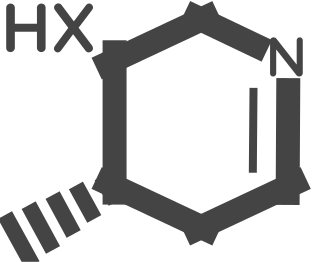 Structure

 P&D probe-likeness score

Structure formats
[[ format ]]
[[ compound[format === 'MOL' ? 'molblock' : format.toLowerCase()] ]]
Description
(extracted from source data)
PRICE
29
METABOLISM
Not metabolized;
DESCRIPTION
Eflornithine is an irreversible ornithine decarboxylase inhibitor and is a partial inhibitor of arginase enzymes . Marketed formulations may contain eflornithine hydrochloride (PubChem CID 57004).
Eflornithine has recently been reported to provide neuroprotective effects in a mouse model of Alzheimer's disease (AD) . The authors identify microglial-induced arginine depletion as a causative factor in AD pathophysiology in their model, focussing on inhibition of arginine catabolising enzymes as a novel mechanism by which to halt the neurodegeneration observed in AD. These findings suggest that eflornithine could be used as a starting point for medicinal chemists to identify novel compounds with anti-arginase activity in humans. (GtoPdb)
Eflornithine has recently been reported to provide neuroprotective effects in a mouse model of Alzheimer's disease (AD) . The authors identify microglial-induced arginine depletion as a causative factor in AD pathophysiology in their model, focussing on inhibition of arginine catabolising enzymes as a novel mechanism by which to halt the neurodegeneration observed in AD. These findings suggest that eflornithine could be used as a starting point for medicinal chemists to identify novel compounds with anti-arginase activity in humans. (GtoPdb)
PRICE
29
DESCRIPTION
Eflornithine hydrochloride is a specific, irreversible inhibitor of the enzyme ornithine decarboxylase. Eflornithine is a medication for the treatment of African trypanosomiasis and excessive facial hair growth in women.
DESCRIPTION
Eflornithine is a medication used topically to reduce unwanted facial hair growth in women. The postulated mechanism of action is through irreversible inhibition of ornithine decarboxylase (ODC) in the skin.
(Enamine Bioactive Compounds)
DESCRIPTION
Eflornithine hydrochloride hydrate (DFMO hydrochloride hydrate) is a specific and irreversible inhibitor of the ornithine decarboxylase (ODC). Eflornithine hydrochloride hydrate has antitumor activity and has also been used in the hirsutism Eflornithine hydrochloride hydrate has antitumor activity and is also used in the treatment of hirsutism.
(TargetMol Bioactive Compound Library)
DESCRIPTION
Eflornithine (DFMO) is a selective and orally available ornithine decarboxylase inhibitor that delays hair overgrowth.Eflornithine is used in the study of African trypanosomiasis, malignant glioma, and sleeping sickness.
(TargetMol Bioactive Compound Library)
DESCRIPTION
Selective irreversible ornithine decarboxylase (ODC) inhibitor.
(LOPAC library)
DESCRIPTION
Eflornithine hydrochloride is a drug found to be effective in the treatment of facial hirsutism. It is a "suicide inhibitor," irreversibly binding to Ornithine Decarboxylase (ODC) and preventing the natural substrate ornithine from accessing the active site.
(BOC Sciences Bioactive Compounds)
DESCRIPTION
IGF1R inhibitor
(Tocris Bioactive Compound Library)
[[ p.pathway_name ]]
[[ compound.targets[tid].gene_name ]]

Cell lines
0

Organisms
4
Compound Sets
34
BOC Sciences Bioactive Compounds
Cayman Chemical Bioactives
CeMM library of unique drugs (CLOUD)
ChEMBL Approved Drugs
ChEMBL Drugs
Concise Guide to Pharmacology 2017/18
Concise Guide to Pharmacology 2019/20
Concise Guide to Pharmacology 2021/22
Concise Guide to Pharmacology 2023/24
CZ-OPENSCREEN Bioactive Library
Drug Repurposing Hub
DrugBank
DrugBank Approved Drugs
DrugCentral
DrugCentral Approved Drugs
DrugMAP
DrugMAP Approved Drugs
DrugMatrix
Enamine Bioactive Compounds
Enamine BioReference Compounds
Guide to Pharmacology
LOPAC library
Mcule NIBR MoA Box Subset
Natural product-based probes and drugs
NCATS Inxight Approved Drugs
Novartis Chemogenetic Library (NIBR MoA Box)
NPC Screening Collection
ReFrame library
Selleckchem Bioactive Compound Library
The Pathogen Box
The Spectrum Collection
Tocris Bioactive Compound Library
[[ a.name ]]
[[ ligand_id ]]
free of charge
External IDs
73

Molecular Weight
182.09
Hydrogen Bond Acceptors
3
Hydrogen Bond Donors
3
Rotatable Bonds
5
Ring Count
0
Aromatic Ring Count
0
cLogP
-0.23
TPSA
89.34
Fraction CSP3
0.83
Chiral centers
1.0
Largest ring
0.0
QED
0.55

Structural alerts
0
No structural alerts detected

Related compounds
Custom attributes
(extracted from source data)
Selectivity
ODC
Disease
REFERENCE COMPOUNDS
MOA
protozoal ornithine decarboxylase inhibitor
ornithine decarboxylase inhibitor
Inhibitor
Ornithine Decarboxylase Inhibitors
Target
Ornithine decarboxylase
Parasite
Decarboxylase
ARG2, ODC1
Primary Target
Decarboxylases
Member status
member
Indication
facial hair reduction
Pathway
Microbiology/virology
Anti-infection
Metabolism
Biosynthetic Origin
Other (Amino Acid)
Therapeutic Indication
Antiparasitic
Therapeutic Class
Antimicrobial
Anticancer Agents
Source data