
General
Preferred name
LEVAMLODIPINE
Synonyms
(S)-Amlodipine ()
S-amlodipine ()
(S)-Amlodipine Besylate (103129-82-4(free base)) ()
Levamlodipine (besylate) ()
Levoamlodipine ()
(S)-Amlodipine (besylate) ()
Levoamlodipine (besylate) ()
Levamlodipine besylate ()
LEVAMLODIPINE MALEATE ()
LEVAMLODIPINE MALATE ()
Levamlodipino ()
Levamlodipine component of agsav301 ()
Amlodipine, (s)- ()
Conjupri ()
Amlodipine maleate, s- ()
Levamlodipine l-malate ()
P&D ID
PD008989
CAS
103129-82-4
736178-83-9
150566-71-5
Tags
available
drug candidate
drug
Drug indication
Hypertension
Drug Status
approved
investigational
Max Phase
1.0
4.0
First approval
2019

Probe control
Probe control not defined

Orthogonal probes
0
No orthogonal probes found

Similar probes
0
No structurally similar probes found
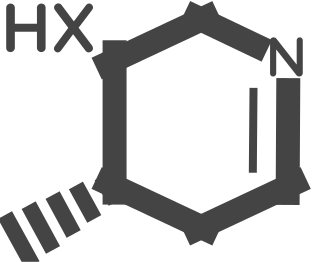 Structure

 P&D probe-likeness score

Structure formats
[[ format ]]
[[ compound[format === 'MOL' ? 'molblock' : format.toLowerCase()] ]]
Description
(extracted from source data)
MOA
Levamlodipine blocks the transmembrane influx of calcium into the vascular and cardiac smooth muscles resulting in vasodilation and a subsequent decrease in blood pressure. This drug is an allosteric modulator and acts on the _L-type calcium channels_. It exerts the same mechanism of action, differing only in its form as an enantiomer [L1485].; ; The exact mechanisms by which levamlodipine relieves angina have not been fully understood, but the mechanism is thought to be twofold. Firstly, the modulation of calcium influx caused by levamlodipine leads to decreased peripheral resistance by arteriolar vasodilatation and subsequent reduction in oxygen requirement for cardiac muscle. Secondly, a decrease in coronary vascular resistance which can lead to an increase in coronary blood flow.; ; Negative inotropic effects can be demonstrated in vitro but such effects have not been observed in live animals at therapeutic doses [L1485].; ; Receptor binding studies of amlodipine have shown that out of the two enantiomer forms, only the (S) enantiomer of amlodipine (levamlodipine) binds to and blocks L-type calcium channels. The (R) enantiomer has no activity on these channels [L1484].; ;
ABSORPTION
After oral administration of therapeutic doses, absorption produces peak plasma concentrations between 6 and 12 hours. Absolute bioavailability has been estimated to be between 64 and 90%. The bioavailability of amlodipine besylate tablets is not altered by the presence of food [L1485].;
HALF-LIFE
The plasma elimination half-life of this drug is 31 ± 13 hrs [L1484].
METABOLISM
Extensively (about 90%) converted to its inactive metabolites by hepatic metabolism. Approximately 10% of the unchanged parent compound and 60% of its metabolites are excreted in the urine [L1487].; ; Studies suggest that CYP3A4, rather than CYP3A5, plays a key role in the metabolic clearance of amlodipine in humans [A32032].; ; In a metabolic study, or amlodipine enantiomers, S-amlodipine (levamlodipine) was slowly metabolized in human liver microsomes in vitro. Amlodipine dehydrogenation to the pyridine its metabolite, M9; the molecule underwent further underwent oxidative deamination, O-demethylation, and O-dealkylation. These in vitro metabolism data are consistent with amlodipine metabolism and disposition observed in vivo in humans. Data derived from amlodipine metabolism study in expressed P450 in human liver microsomes with P450 inhibitors indicate that _CYP3A4_ is the primary contributor to amlodipine dehydrogenation, rather than other liver enzymes such as _CYP3A5_ [A32034].
PRICE
29
DESCRIPTION
Levamlodipine ((S)-Amlodipine) is a powerful dihydropyridine calcium channel blocker, possessing vasodilation properties and used in the treatment of hypertension and angina[1].
DESCRIPTION
Levamlodipine besylate ((S)-Amlodipine besylate) is an orally active calcium channel blocker with antioxidant and vasodilatory properties. Levamlodipine besylate can reduce serum malondialdehyde (MDA) levels, increase superoxide dismutase (SOD) activity, and improve oxidative stress. Levamlodipine besylate can be used for research on vascular dementia, hypertension, and cerebrovascular diseases[1][2][3][4].
PRICE
35
DESCRIPTION
Levamlodipine (S-amlodipine) belongs to the dihydropyridine group of calcium channel blockers. Levamlodipine, also known as S-amlodipine, is a pharmacologically active enantiomer of amlodipine, an antihypertensive and anti-anginal medication. The names S-amlodipine and levamlodipine may be used interchangeably as both substances are the same, however, with differing nomenclature. As a racemic mixture, amlodipine contains (R) and (S)-amlodipine isomers, but only (S)-amlodipine as the active moiety possesses therapeutic activity.
(TargetMol Bioactive Compound Library)
DESCRIPTION
Levamlodipine besylate ((S)-Amlodipine Besylate (103129-82-4(free base))) , also known as S-amlodipine, is a pharmacologically active enantiomer of amlodipine, an antihypertensive and anti-anginal medication. Levamlodipine besylate belongs to the dihydropyridine group of calcium channel blockers. The names S-amlodipine and levamlodipine may be used interchangeably as both substances are the same, however, with differing nomenclature. As a racemic mixture, amlodipine contains (R) and (S)-amlodipine isomers, but only (S)-amlodipine as the active moiety possesses therapeutic activity.
(TargetMol Bioactive Compound Library)
[[ p.pathway_name ]]
[[ compound.targets[tid].gene_name ]]

Compound Sets
13
AdooQ Bioactive Compound Library
ChEMBL Approved Drugs
ChEMBL Drugs
Drug Repurposing Hub
DrugBank
DrugBank Approved Drugs
DrugCentral
DrugCentral Approved Drugs
DrugMAP
NCATS Inxight Approved Drugs
Selleckchem Bioactive Compound Library
[[ a.name ]]
[[ ligand_id ]]
free of charge
External IDs
46

Molecular Weight
408.15
Hydrogen Bond Acceptors
7
Hydrogen Bond Donors
2
Rotatable Bonds
8
Ring Count
2
Aromatic Ring Count
1
cLogP
2.27
TPSA
99.88
Fraction CSP3
0.4
Chiral centers
1.0
Largest ring
6.0
QED
0.5

Structural alerts
0
No structural alerts detected

Related compounds
Custom attributes
(extracted from source data)
Target
Calcium Channel
SOD
Indication
hypertension
MOA
calcium channel blocker
Pathway
Immunology/Inflammation
Membrane Transporter/Ion Channel
Neuronal Signaling
Metabolism
Source data