
General
Preferred name
CITRIC ACID
Synonyms
Citrate ()
Citro ()
Citretten ()
ANHYDROUS CITRIC ACID ()
citric-acid ()
SODIUM CITRATE ()
CITRIC ACID MONOHYDRATE ()
Citric acid hydrate ()
Citric acid,anhydrous ()
Citric acid component of phexxi ()
Citric acid,hydrous ()
Citric acid monoglyceride ()
NSC-112226 ()
Citric acid, hydrous ()
NSC-30279 ()
Citric acid component of clenpiq ()
E-330 ()
Citric acid bp ()
Urologic G ()
Citric acid component of prepopik ()
INS-330 ()
FEMA NO. 2306 ()
B1650 ()
NSC-626579 ()
Acidum citricum monohydrate ()
Acidum citricum ()
INS NO.330 ()
Citric acid component of renacidin ()
Citric acid anhydrous ()
E330 ()
Aciletten ()
Citricum acidum ()
Citric acid, anhydrous ()
P&D ID
PD008874
CAS
126-44-3
12262-73-6
77-92-9
5949-29-1
Tags
available
drug candidate
drug
Approved by
FDA
First approval
1982
Drug indication
Discovery agent
Acute kidney injury
Renal insufficiency
Drug Status
vet_approved
approved
nutraceutical
Max Phase
4.0

Probe control
Probe control not defined

Orthogonal probes
0
No orthogonal probes found

Similar probes
0
No structurally similar probes found
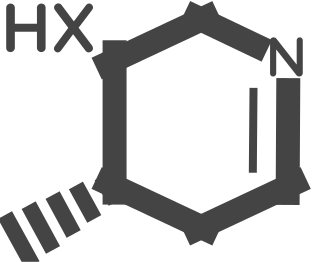 Structure

 P&D probe-likeness score

Structure formats
[[ format ]]
[[ compound[format === 'MOL' ? 'molblock' : format.toLowerCase()] ]]
Description
(extracted from source data)
DESCRIPTION
Citric acid is a natural preservative and food tartness enhancer. Citric acid induces apoptosis and cell cycle arrest at G2/M phase and S phase in HaCaT cells. Citric acid cause oxidative damage of the liver by means of the decrease of antioxidative enzyme activities. Citric acid causes renal toxicity in mice[1][2][3].
PRICE
29
PRICE
29
DESCRIPTION
1. Citric acid (Citro) (1-2 g/kg) can decrease brain lipid peroxidation and inflammation, liver damage, and DNA fragmentation. 2. Citric acid denture cleansers can reduce C. albicans biofilm accumulation and cell viability. However, this CT did not prevent biofilm recolonization.
(TargetMol Bioactive Compound Library)
DESCRIPTION
Citric Acid Monohydrate is a tricarboxylic acid found in citrus fruits. Citric acid is used as an excipient in pharmaceutical preparations due to its antioxidant properties. It maintains stability of active ingredients and is used as a preservative.
(TargetMol Bioactive Compound Library)
[[ p.pathway_name ]]
[[ compound.targets[tid].gene_name ]]
Cell lines
1

Organisms
0
Compound Sets
25
ChEMBL Approved Drugs
ChEMBL Drugs
Concise Guide to Pharmacology 2017/18
Concise Guide to Pharmacology 2019/20
Concise Guide to Pharmacology 2021/22
Concise Guide to Pharmacology 2023/24
CZ-OPENSCREEN Bioactive Library
Drug Repurposing Hub
DrugBank
DrugBank Approved Drugs
DrugCentral
DrugCentral Approved Drugs
DrugMatrix
Guide to Pharmacology
JUMP-Target 1 Compound Set
MedChem Express Bioactive Compound Library
NCATS Inxight Approved Drugs
NPC Screening Collection
Other bioactive compounds
ReFrame library
Selleckchem Bioactive Compound Library
The Spectrum Collection
ZINC Tool Compounds
[[ a.name ]]
[[ ligand_id ]]
free of charge
External IDs
79

Molecular Weight
192.03
Hydrogen Bond Acceptors
4
Hydrogen Bond Donors
4
Rotatable Bonds
5
Ring Count
0
Aromatic Ring Count
0
cLogP
-1.25
TPSA
132.13
Fraction CSP3
0.5
Chiral centers
0.0
Largest ring
0.0
QED
0.43

Structural alerts
0
No structural alerts detected

Related compounds
Custom attributes
(extracted from source data)
Target
antibiotic
Apoptosis
Bacterial
Endogenous Metabolite
AKR1B1, ANG, APRT, BHMT, C8G, CA4, CPB1, CS, CTDSP1, GNMT, HGS, HS3ST3A1, IL4I1, ITPA, LSM6, MDH2, MIF, PDE5A, PKD2L1, PLEKHA1, RNASE1, RNASE3, SRC, TNFSF13B, UCK2
RNASE1
MOA
coagulation factor inhibitor
Pathway
Metabolism
Microbiology/virology
Anti-infection
Metabolic Enzyme/Protease
Source data