
General
Preferred name
DEQUALINIUM
Synonyms
DEQUALINIUM CHLORIDE ()
Dequalinium chloride hydrate ()
Dequafungan ()
Danical ()
Decabis ()
Dequalinium dichloride ()
Dequalinium (Chloride) ()
Nordman ()
Dequacets ()
Dekamin ()
Chlorure de dequalinium ()
BAQD 10 ()
Dequadin ()
NSC-166454 ()
Labosept ()
Fluomizin ()
GNF-Pf-5483 ()
BAQD-10 ()
Decamine ()
Cloruro de decualinio ()
Dequalinium cation ()
P&D ID
PD006879
CAS
6707-58-0
522-51-0
Tags
available
drug
Drug indication
Myelopathy
Bacterial vaginosis
Drug Status
approved
withdrawn
investigational
Max Phase
4.0

Probe control
Probe control not defined

Orthogonal probes
0
No orthogonal probes found

Similar probes
0
No structurally similar probes found
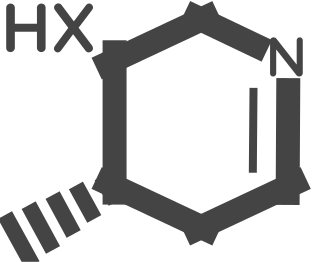 Structure

 P&D probe-likeness score

Structure formats
[[ format ]]
[[ compound[format === 'MOL' ? 'molblock' : format.toLowerCase()] ]]
Description
(extracted from source data)
PRICE
29
MOA
Dequalinium has a multiple mode of action. It disrupts the cell permeability of the bacteria by absorbing onto the bacterial cell surface and diffusing across the membrane. It also binds to the cytoplasmic membrane with subsequent formation of complexes and protein precipitation and lyses the membrane in adequate concentrations, perturbing osmotic exchange. Loss of normal enzymatic activity is achieved through several different processes. Denaturation of proteins results in inhibition of bacterial cell metabolism. Disruption of bacterial energy production is mediated through inhibition of glucose metabolism and inhibition of mitochondrial ATP synthesis via inhibition of bacterial F1-ATPase. Protein synthesis is also terminated at the level of ribosomes. Bacterial nucleic acids are also affected through direct binding of the drug to DNA in vitro, and precipitation of cytoplasmic material with nucleic acids being the most sensitive [A19280]. ; The cationic form of dequalinium accumulates in the mitochondria and promotes anticancer activity in human leukemia cells. It mediates a cytotoxic effect by altering redox balance in cells and downregulating Raf/MEK/ERK1/2 and PI3K/Akt signaling pathways in these cells which leads to cell death by apoptosis and/or necrosis [A19290, A19291, A19292]. ; Dequalinium inhibits mycothiol ligase activity in Mycobacterium tuberculosis strains [A19298].
DESCRIPTION
While the INN-assigned preparation of dequalinium is in complex with chloride, the compound is also available experimentally as the 'parent' salt form. Two of the references listed here refer to the parent compound, while and refer to dequalinium chloride. We show the structure of the parent compound, and our external links are also to this structure.
(GtoPdb)
DESCRIPTION
Selective blocker of apamin-sensitive K+ channels
(LOPAC library)
DESCRIPTION
Dequalinium Chloride is a PKC inhibitor with IC50 of 7-18 μM, and also a selective blocker of apamin-sensitive K+ channels with IC50 of 1.1 μM.
(BOC Sciences Bioactive Compounds)
DESCRIPTION
Dequalinium chloride (Decabis) , a topical bacteriostat, is a selective blocker of apamin-sensitive K+ channels. It is used in wound dressings and mouth infections and may also have antifungal action, but may cause skin ulceration.
(TargetMol Bioactive Compound Library)
[[ p.pathway_name ]]
[[ compound.targets[tid].gene_name ]]

Cell lines
0

Organisms
5
Compound Sets
28
BOC Sciences Bioactive Compounds
Cayman Chemical Bioactives
ChEMBL Approved Drugs
ChEMBL Drugs
Concise Guide to Pharmacology 2017/18
Concise Guide to Pharmacology 2019/20
Concise Guide to Pharmacology 2021/22
Concise Guide to Pharmacology 2023/24
CZ-OPENSCREEN Bioactive Library
Drug Repurposing Hub
DrugBank
DrugBank Approved Drugs
DrugCentral
DrugCentral Approved Drugs
DrugMAP
DrugMatrix
EU-OPENSCREEN Bioactive Compound Library
Guide to Pharmacology
Ki Database
LOPAC library
LSP-MoA library (Laboratory of Systems Pharmacology)
MedChem Express Bioactive Compound Library
NIH Mechanistic Set
Other bioactive compounds
Prestwick Chemical Library
ReFrame library
TargetMol Bioactive Compound Library
The Spectrum Collection
[[ a.name ]]
[[ ligand_id ]]
free of charge
External IDs
57

Molecular Weight
456.32
Hydrogen Bond Acceptors
2
Hydrogen Bond Donors
2
Rotatable Bonds
11
Ring Count
4
Aromatic Ring Count
4
cLogP
6.17
TPSA
59.8
Fraction CSP3
0.4
Chiral centers
0.0
Largest ring
6.0
QED
0.21

Structural alerts
2
aggregator (Aggregator Advisor)
Aggregators
aggregator (ZINC)
Aggregators

Related compounds
Custom attributes
(extracted from source data)
Target
PKC
Potassium Channel
KCNN1, KCNN3
Apoptosis
Bacterial
nAChR
Parasite
Indication
first-aid antiseptic
MOA
PKC inhibitor
Pathway
Chromatin/Epigenetic
Cytoskeletal Signaling
Membrane Transporter/Ion Channel
Anti-infection
Neuronal Signaling
Source data