
General
Preferred name
NU6027
Synonyms
NU-6027 ()
NU 6027 ()
6-CYCLOHEXYLMETHYLOXY-5-NITROSO-PYRIMIDINE-2,4-DIAMINE ()
P&D ID
PD004516
CAS
220036-08-8
Tags
available
drug candidate
Drug indication
Discovery agent
Drug Status
experimental

Probe control
Probe control not defined

Orthogonal probes
0
No orthogonal probes found

Similar probes
0
No structurally similar probes found
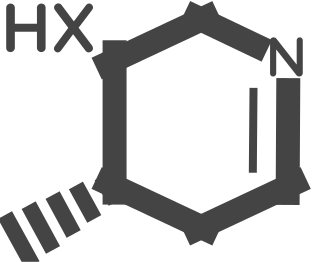 Structure

 P&D probe-likeness score

Structure formats
[[ format ]]
[[ compound[format === 'MOL' ? 'molblock' : format.toLowerCase()] ]]
Description
(extracted from source data)
DESCRIPTION
NU6027 is a potent and ATP-competitive inhibitor of both CDK1 and CDK2, with Kis of 2.5 ¦ÌM and 1.3 ¦ÌM, respectively. NU6027 is also a potent inhibitor of ATR and enhances hydroxyurea and cisplatin cytotoxicity in an ATR-dependent manner[1][2].
PRICE
37
DESCRIPTION
NU6027 is a potent ATR/CDK inhibitor, inhibits CDK1/2, ATR and DNA-PK with Ki of 2.5 ??M/1.3 ??M, 0.4 ??M and 2.2 ??M, enter cells more readily than the 6-aminopurine-based inhibitors.
DESCRIPTION
NU6027 is a potent inhibitor of cellular ATR activity (IC(50)=6.7 μM) and enhanced hydroxyurea and cisplatin cytotoxicity in an ATR-dependent manner. NU6027 attenuated G2/M arrest following DNA damage, inhibited RAD51 focus formation and increased the cytotoxicity of the major classes of DNA-damaging anticancer cytotoxic therapy but not the antimitotic, paclitaxel. In A2780 cells sensitisation to cisplatin was greatest in cells with functional p53 and mismatch repair (MMR) and sensitisation to temozolomide was greatest in p53 mutant cells with functional MMR. Importantly, NU6027 was synthetically lethal when DNA single-strand break repair is impaired either through poly(ADP-ribose) polymerase (PARP) inhibition or defects in XRCC1. NU6027 inhibits ATR, impairing G2/M arrest and homologous recombination thus increasing sensitivity to DNA-damaging agents and PARP inhibitors. It provides proof of concept data for clinical development of ATR inhibitors.
(BOC Sciences Bioactive Compounds)
DESCRIPTION
NU6027 is a potent ATR/CDK inhibitor, inhibits CDK1/2, ATR and DNA-PK with Ki of 2.5 μM/1.3 μM, 0.4 μM and 2.2 μM, enter cells more readily than the 6-aminopurine-based inhibitors.
(TargetMol Bioactive Compound Library)
[[ p.pathway_name ]]
[[ compound.targets[tid].gene_name ]]

Cell lines
1

Organisms
0

Compound Sets
9
BOC Sciences Bioactive Compounds
Cayman Chemical Bioactives
CDK inhibitor database (CDKiDB)
Drug Repurposing Hub
DrugBank
DrugMAP
MedChem Express Bioactive Compound Library
Selleckchem Bioactive Compound Library
TargetMol Bioactive Compound Library
[[ a.name ]]
[[ ligand_id ]]
free of charge
External IDs
40

Molecular Weight
251.14
Hydrogen Bond Acceptors
7
Hydrogen Bond Donors
2
Rotatable Bonds
4
Ring Count
2
Aromatic Ring Count
1
cLogP
2.0
TPSA
116.48
Fraction CSP3
0.64
Chiral centers
0.0
Largest ring
6.0
QED
0.79

Structural alerts
0
No structural alerts detected

Related compounds
Custom attributes
(extracted from source data)
Target
ATM/ATR
ATR
CDK
CDK1
CDK2
DNA-PK
CCNA2, CDK2
MOA
CDK inhibitor
Pathway
Cell Cycle/DNA Damage
PI3K/Akt/mTOR
Cell Cycle/Checkpoint
DNA Damage/DNA Repair
PI3K/Akt/mTOR signaling
Solubility
Soluble in DMSO
Source data