
General
Preferred name
SIROLIMUS
Synonyms
AY-22989,Sirolimus,WY-090217 ()
Rapamycin ()
Rapamune, AY-22989, Sirolimus, WY-090217 ()
AY 22989 ()
NSC-2260804 ()
Rapamycin (Sirolimus) ()
AY-22989 ()
Rapamune, Sirolimus, NSC-2260804,AY-22989 ()
Rapamycin (AY-22989) ()
SirolimusRapamuneRapamycin(-)-RapamycinAntibiotic AY 22989SIIA 9268AAY 22989Wy 09021723,27-Epoxy-3H-pyrido[2,1-c][1,4]oxaazacyclohentriacontine- 1,5,11,28,29(4H,6H,31H)-pentone, 9,10,12,13,14,21,22,23,24, 25,26,27,32,33,34,34a-hexadecahydro-9,27-dihydroxy- 3-[2-(4-hydroxy-3-methoxycyclohexyl)-1-methylethyl]- 10,21-dimethoxy-6,8,12,14,20,26-hexamethyl-, [3S-[3R*[S* (1R*,3S*,4S*)],6S*,7E,9S*,10S*,12S*,14R*,15E,17E,19E,21R*, 23R*,26S*,27S*,34aR*]]-Rapamycin ()
NPC-12G ()
HYFTOR ()
Rapamune ()
Sirolimus component of nab-rapamycin rapamycin ()
L04AA10 ()
RAPALIMUS ()
NSC-226080 ()
SIROLIMUS COMPONENT OF SM-88 ()
FYARRO ()
WY-090217 ()
(-)-Rapamycin ()
SIROLIMUS COMPONENT OF NAB-RAPAMYCIN RAPAMYCIN ()
P&D ID
PD003301
CAS
53123-88-9
Tags
available
probe
drug
Approved by
EMA
PMDA
FDA
First approval
1999
Drug indication
Coronavirus Disease 2019 (COVID-19)
Dutch elm disease
acute lymphoblastic leukemia
Middle East Respiratory Syndrome (MERS)
Multiple myeloma
Severe acute respiratory syndrome (SARS)
Organ transplant rejection
Drug Status
approved
investigational
Max Phase
4.0

Probe info
Probe type
calculated probe
experimental probe
Probe sources
Chemical Probes.org
Tool Compound Set
Probe targets
[[ compound.targets[t].gene_name ]]

Probe control
Probe control not defined

Orthogonal probes
226
No orthogonal probes found

Similar probes
1
No structurally similar probes found
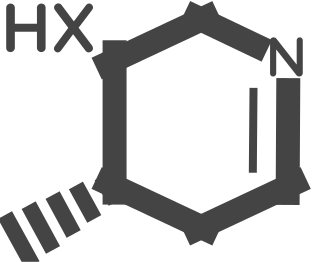 Structure

 P&D probe-likeness score

Structure formats
[[ format ]]
[[ compound[format === 'MOL' ? 'molblock' : format.toLowerCase()] ]]
Description
(extracted from source data)
COMMENT
Rapamycin (also known as sirolimus) is a well established Mammalian Target of Rapamycin (mTOR; FRAP1) Inhibitor. Other validated mechanisms of action include cytochrome P450 (various isoforms) inhibition and P-glycoprotein (MDR-1; ABCB1) inhibition. Rapamycin is a naturally occurring macrolide produced by the bacterium Streptomyces hygroscopicus. Several semisynthetic 'rapalogs' have been generated which alter key pharmaceutical properties of the probe. These agents include everolimus, ridaforolimus and temsirolimus. Rapamycin and the rapalogs are wonderful agents for interrogating Mammalian Target of Rapamycin (mTOR; FRAP1) and can ideally be used alongside synthetic inhibitors (such as Vistusertib) which often target both the mTORC1 and mTORC2 complex (as well as the phosphatidylinositol 3-kinase (PI3K) enzyme class). Jun 30 2016 - 12:38am
DESCPRITION
A macrolide compound obtained from Streptomyces hygroscopicus that acts by selectively blocking the transcriptional activation of cytokines thereby inhibiting cytokine production. It is bioactive only when bound to IMMUNOPHILINS. Sirolimus is a potent immunosuppressant and possesses both antifungal and antineoplastic properties.
DESCRIPTION
Rapamycin (Sirolimus; AY 22989) is a potent and specific mTOR inhibitor with an IC50 of 0.1 nM in HEK293 cells. Rapamycin binds to FKBP12 and specifically acts as an allosteric inhibitor of mTORC1[1]. Rapamycin is an autophagy activator, an immunosuppressant[2].
DESCRIPTION
Sirolimus is a macrolide produced by the bacteria Streptomyces hygroscopicus. It has potent immunosuppressive and antiproliferative properties. Sirolimus is classified as a Type IV allosteric kinase inhibitor .
(GtoPdb)
MOA
Inhibitor
(Chemical Probes.org)
DESCRIPTION
inhibitor of mTOR
(Informer Set)
DESCRIPTION
Sirolimus is an immunosuppressant used to prevent organ transplant rejections and to treat lymphangioleiomyomatosis. It acts by selectively blocking the transcriptional activation of cytokines thereby inhibiting cytokine production.
(Enamine Bioactive Compounds)
DESCRIPTION
Rapamycin (AY 22989) is a natural product of macrolides, an mTOR inhibitor with specificity (HEK293 cells: IC50=0.1 nM). Rapamycin has immunosuppressive activity and induces autophagy.
(TargetMol Bioactive Compound Library)
DESCRIPTION
DNA topoisomerase I inhibitor
(Tocris Bioactive Compound Library)
[[ p.pathway_name ]]
[[ compound.targets[tid].gene_name ]]
Cell lines
369

Organisms
6

Compound Sets
35
AdooQ Bioactive Compound Library
Axon Medchem Screening Library
Cayman Chemical Bioactives
ChEMBL Approved Drugs
ChEMBL Drugs
Chemical Probes.org
Clinical kinase drugs
Drug Repurposing Hub
DrugBank
DrugBank Approved Drugs
DrugCentral
DrugCentral Approved Drugs
DrugMAP Approved Drugs
Enamine Bioactive Compounds
Enamine BioReference Compounds
EU-OPENSCREEN Bioactive Compound Library
EUbOPEN Chemogenomics Library
Guide to Pharmacology
Informer Set
JUMP-MOA Compound Set
Kinase Inhibitors (best-in-class)
LSP-MoA library (Laboratory of Systems Pharmacology)
LSP-OptimalKinase library (Laboratory of Systems Pharmacology)
MedChem Express Bioactive Compound Library
NCATS Inxight Approved Drugs
NIH Approved Oncology Drugs
NIH Mechanistic Set
Reference compounds for characterizing cellular injury in high-content cellular morphology assays
ReFrame library
Selleckchem Bioactive Compound Library
TargetMol Bioactive Compound Library
Tocris Bioactive Compound Library
Tool Compound Set
Welcome Trust Cancer Drugs
[[ a.name ]]
[[ ligand_id ]]
free of charge
External IDs
54

Molecular Weight
913.56
Hydrogen Bond Acceptors
13
Hydrogen Bond Donors
3
Rotatable Bonds
6
Ring Count
4
Aromatic Ring Count
0
cLogP
6.18
TPSA
195.43
Fraction CSP3
0.75
Chiral centers
15.0
Largest ring
29.0
QED
0.16

Structural alerts
0
No structural alerts detected

Related compounds
Custom attributes
(extracted from source data)
Target
MTOR
FRAP
Serine/threonine-protein kinase mTOR
FKBP1A, MTOR
Antineoplastic and Immunosuppressive Antibiotics,Autophagy,mTOR
antibiotic
Bacterial
Endogenous Metabolite
FKBP
Fungal
Compound status
FDA
Pathway
TOR signaling
Autophagy
Metabolism
Microbiology/virology
PI3K/Akt/mTOR signaling
Anti-infection
Apoptosis
Cell Cycle/DNA Damage
Immunology/Inflammation
Metabolic Enzyme/Protease
PI3K/Akt/mTOR
Kinase group
Atypical
Primary Target
mTOR
MOA
Inhibitor
Autophagy activator
mTOR inhibitor
Disease Area
transplant, pulmonary
Indication
organ rejection, lymphangioleiomyomatosis
Target class
Protein kinase
Kinase
Orthogonal probe
eCF309
Therapeutic Class
Immunosuppressive Agents
Antiviral Agents
Recommended Cell Concentration
100 nM
Source data