
General
Preferred name
ACITRETIN
Synonyms
Acitretin (sodium) ()
Ro 10-1670 sodium ()
Ro 10-1670 ()
Etretin ()
Etretin, RO 10-1670 ()
Acitretin sodium ()
RO 10-1670 ()
Ro-10-1670-000 ()
Ro-101670000 ()
Soriatane ()
Acitretina ()
Neotigason ()
RO-10-1670/000 ()
RO 10-1670/000 ()
Acitretine ()
Acitretin-d3 ()
P&D ID
PD003196
CAS
55079-83-9
54757-46-9
925701-88-8
Tags
available
drug
Approved by
FDA
First approval
1996
Drug indication
psoriasis
Psoriasis vulgaris
Drug Status
approved
withdrawn
Max Phase
4.0

Probe control
Probe control not defined

Orthogonal probes
0
No orthogonal probes found

Similar probes
0
No structurally similar probes found
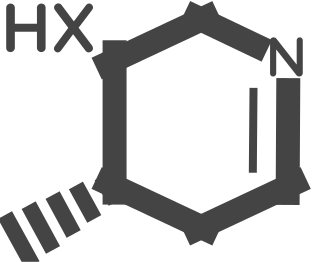 Structure

 P&D probe-likeness score

Structure formats
[[ format ]]
[[ compound[format === 'MOL' ? 'molblock' : format.toLowerCase()] ]]
Description
(extracted from source data)
DESCRIPTION
Acitretin is a second generation retinoid drug. Acitretin is an active metabolite of , but may also be reverse metabolised back to etretinate.
(GtoPdb)
DESCRIPTION
Acitretin (Ro 10-1670) is a second-generation, systemic retinoid that has been used in the treatment of psoriasis. Acitretin also can be used for the research of Alzheimer¡¯s disease[1][2][3].
PRICE
30
DESCRIPTION
Acitretin is an oral retinoid used in the treatment of severe psoriasis. Retinoids have a structure similar to vitamin A and are involved in the normal growth of skin cells. Acitretin works by inhibiting the excessive cell growth and keratinisation seen in psoriasis.
(Enamine Bioactive Compounds)
DESCRIPTION
Acitretin (Ro 10-1670) is a second-generation systemic retinoid used in the treatment of psoriasis.
(TargetMol Bioactive Compound Library)
DESCRIPTION
Acitretin sodium is a second-generation, systemic retinoid that has been used in the treatment of psoriasis. It can be considered one of the treatments of choice for pustular and erythrodermic psoriasis. However, the efficacy of acitretin sodium as a monotherapy for plaque psoriasis is less, although it is often used in combination therapy with other systemic psoriasis therapies, especially ultraviolet B or psoralen plus ultraviolet A phototherapy, to increase efficacy. Such combination treatments may potentially minimise toxicity by using lower doses of each of the two agent.
(BOC Sciences Bioactive Compounds)
[[ p.pathway_name ]]
[[ compound.targets[tid].gene_name ]]
Compound Sets
26
AdooQ Bioactive Compound Library
BOC Sciences Bioactive Compounds
CeMM library of unique drugs (CLOUD)
ChEMBL Approved Drugs
ChEMBL Drugs
CZ-OPENSCREEN Bioactive Library
Drug Repurposing Hub
DrugBank
DrugBank Approved Drugs
DrugCentral
DrugCentral Approved Drugs
DrugMAP
DrugMAP Approved Drugs
Enamine Bioactive Compounds
Enamine BioReference Compounds
Guide to Pharmacology
MedChem Express Bioactive Compound Library
NIH Clinical Collections (NCC)
NPC Screening Collection
Other bioactive compounds
Prestwick Chemical Library
ReFrame library
Selleckchem Bioactive Compound Library
TargetMol Bioactive Compound Library
Withdrawn 2.0
[[ a.name ]]
[[ ligand_id ]]
free of charge
External IDs
50

Molecular Weight
326.19
Hydrogen Bond Acceptors
2
Hydrogen Bond Donors
1
Rotatable Bonds
6
Ring Count
1
Aromatic Ring Count
1
cLogP
5.17
TPSA
46.53
Fraction CSP3
0.29
Chiral centers
0.0
Largest ring
6.0
QED
0.58

Structural alerts
0
No structural alerts detected

Related compounds
Custom attributes
(extracted from source data)
Target
RAR/RXR
Autophagy
Retinoid Receptor
RARA, RARB, RARG, RBP1, RXRA, RXRB, RXRG, STAT3
RAR
RXR
Pathway
Metabolic Enzyme/Protease
Apoptosis
Metabolism
Vitamin D Related/Nuclear Receptor
MOA
retinoic acid receptor agonist
Retinoid Receptor agonist
Indication
psoriasis
ATC
D05BB02
Toxicity type
reproductive
Therapeutic Class
Keratolytic Agents
Source data