
General
Preferred name
BUPROPION
Synonyms
BUPROPION HYDROCHLORIDE ()
Amfebutamone ()
Wellbutrin ()
Bupropion hyderochloride ()
Amfebutamone (Bupropion) HCl ()
BUPROPION HYDROBROMIDE ()
Bupropion (hydrochloride) ()
Bupropion-d9 (hydrochloride) ()
Bupropion-d9 (hydrochloride) (CRM) ()
Wellbutrin 100 ()
BW323 ()
BW-323 ()
Wellbutrin Sr ()
Wellbutrin Xl ()
Wellbutrin 75 ()
Bupropion hydrochloride component of contrave ()
Forfivo Xl ()
BW 323 ()
Zyban ()
Bupropion hydrochloride component of auvelity ()
NSC-315851 ()
Amfebutamone hydrochloride ()
Mysimba ()
Bupropion HCl ()
Bupropion slow release ()
NSC-758686 ()
Bupropion extended release ()
Bupropione ()
Aplenzin ()
BVF-033 ()
Bupropion hbr ()
Bupropion (hydrochloride) (CRM) ()
P&D ID
PD003148
CAS
34911-55-2
34841-39-9
905818-69-1
31677-93-7
1189725-26-5
Tags
available
drug
Approved by
FDA
First approval
1985
2008
Drug indication
Major depressive disorder
Nicotine dependence
Smoking dependence
Chronic lymphocytic leukemia
Drug Status
approved
withdrawn
Max Phase
4.0

Probe control
Probe control not defined

Orthogonal probes
0
No orthogonal probes found

Similar probes
0
No structurally similar probes found
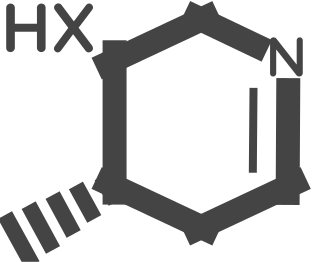 Structure

 P&D probe-likeness score

Structure formats
[[ format ]]
[[ compound[format === 'MOL' ? 'molblock' : format.toLowerCase()] ]]
Description
(extracted from source data)
INDICATION
Bupropion is indicated for the treatment of major depressive disorder (MDD), seasonal affective disorder (SAD), and as an aid to smoking cessation. ; ; When used in combination with [naltrexone] as the marketed product Contraveâ, bupropion is indicated as an adjunct to a reduced-calorie diet and increased physical activity for chronic weight management in adults with an initial body mass index (BMI) of:; â¢30 kg/m^2 or greater (obese) or; â¢27 kg/m^2 or greater (overweight) in the presence of at least one weight-related comorbid condition (e.g., hypertension, type 2 diabetes mellitus, or dyslipidemia).; ; Bupropion is also used off-label as a first-line treatment in patients with ADHD and comorbid bipolar disorder when used as an adjunct to mood stabilizers.[F4624]
DESCRIPTION
The approval status for use of this drug was submitted for re-evaluation by the European Medicines Agency in 2002, following public health concerns around serious adverse reactions associated with its use. These included depression, suicidal thoughts, suicide, seizures, undesirable cardiovascular effects, and angioedema. EU Member States regulatory authorities agreed to keep the product under regular review.
Marketed formulations usually contain bupropion hydrochloride (PubChem CID 62884). (GtoPdb)
Marketed formulations usually contain bupropion hydrochloride (PubChem CID 62884). (GtoPdb)
PHARMACODYNAMICS
Bupropion is chemically unrelated to tricyclic, tetracyclic, selective serotonin re-uptake inhibitors, or other known antidepressant agents. Compared to classical tricyclic antidepressants, Bupropion is a relatively weak inhibitor of the neuronal uptake of norepinephrine and dopamine. In addition, Bupropion does not inhibit monoamine oxidase. Bupropion has been found to be essentially inactive at the serotonin transporter (SERT)(IC50 >10 000 nM,[A178810] however both bupropion and its primary metabolite hydroxybupropion have been found to block the function of cation-selective serotonin type 3A receptors (5-HT3ARs). ; ; Bupropion produces dose-related central nervous system (CNS) stimulant effects in animals, as evidenced by increased locomotor activity, increased rates of responding in various schedule-controlled operant behaviour tasks, and, at high doses, induction of mild stereotyped behaviour [FDA Label]. Due to these stimulant effects and selective activity at dopamine and norepinephrine receptors, bupropion has been identified as having an abuse potential.[FDA Label,A178846] Bupropion has a similar structure to the controlled substance [DB01560], and has been identified as having mild amphetamine-like activity, particularly when inhaled or injected.[A178846]; ; Bupropion is also known to lower the seizure threshold, making any pre-existing seizure conditions a contraindication to its use. This risk is exacerbated when bupropion is combined with other drugs or substances that lower the seizure threshold, such as [cocaine], or in clinical situations that would increase the risk of a seizure such as abrupt alcohol or benzodiazepine withdrawal.[FDA Label] As norepinephrine has been shown to have anticonvulsant properties, bupropion's inhibitory effects on NET are thought to contribute to its pro-convulsant activity.[A178846]; ; Bupropion has been shown to increase blood pressure and pose a risk for exacerbation of unmanaged or pre-existing hypertension,[A178852,FDA Label] however, clinical trials of bupropion in smokers with CVD have not identified an increased incidence of CV events including stroke or heart attack.[A178855] In clinical trials, the mean increase in systolic blood pressure associated with the use of bupropion was found to be 1.3 mmHg.[FDA Label]
METABOLISM
Bupropion is extensively metabolized in humans. Three metabolites are active: hydroxybupropion, which is formed via hydroxylation of the tert-butyl group of bupropion, and the amino-alcohol isomers, threohydrobupropion and erythrohydrobupropion, which are formed via reduction of the carbonyl group. In vitro findings suggest that CYP2B6 is the principal isoenzyme involved in the formation of hydroxybupropion, while cytochrome P450 enzymes are not involved in the formation of threohydrobupropion. Hydroxybupropion has been shown to have the same affinity as bupropion for the norepinephrine transporter (NET) but approximately 50% of its antidepressant activity despite reaching concentrations of ~10-fold higher than that of the parent drug.[A179062]; ; Oxidation of the bupropion side chain results in the formation of a glycine conjugate of meta-chlorobenzoic acid, which is then excreted as the major urinary metabolite. The potency and toxicity of the metabolites relative to bupropion have not been fully characterized. However, it has been demonstrated in an antidepressant screening test in mice that hydroxybupropion is one-half as potent as bupropion, while threohydrobupropion and erythrohydrobupropion are 5-fold less potent than bupropion. This may be of clinical importance because the plasma concentrations of the metabolites are as high as or higher than those of bupropion.[FDA Label]; ; Bupropion and its metabolites exhibit linear kinetics following chronic administration of 300 to 450 mg per day.
DESCRIPTION
Anti-inflammatory, antioxidant and free radical scavenger
(Tocris Bioactive Compound Library)
DESCRIPTION
Non-selective inhibitor of dopamine and noradrenalin transporters
(Tocriscreen Plus)
DESCRIPTION
Selective dopamine reuptake inhibitor; antidepressant
(LOPAC library)
DESCRIPTION
Bupropion is a norepinephrine/dopamine-reuptake inhibitor, it is used most commonly for the management of Major Depressive Disorder, Seasonal Affective Disorder, and as an aid for smoking cessation. Bupropion binds to the dopamine transporter.
(Enamine Bioactive Compounds)
DESCRIPTION
Bupropion is an aminoketone commonly used in the treatment of depression and smoking cessation. Bupropion is a weak inhibitor of neuronal uptake of serotonin and norepinephrine as well as re-uptake of dopamine.
(BOC Sciences Bioactive Compounds)
[[ p.pathway_name ]]
[[ compound.targets[tid].gene_name ]]

Cell lines
0

Organisms
2

Compound Sets
29
Axon Medchem Screening Library
BOC Sciences Bioactive Compounds
ChEMBL Approved Drugs
ChEMBL Drugs
DrugBank
DrugBank Approved Drugs
DrugCentral
DrugCentral Approved Drugs
DrugMAP
DrugMAP Approved Drugs
DrugMatrix
Enamine Bioactive Compounds
Enamine BioReference Compounds
Guide to Pharmacology
Ki Database
LOPAC library
LSP-MoA library (Laboratory of Systems Pharmacology)
Natural product-based probes and drugs
NCATS Inxight Approved Drugs
NIH Clinical Collections (NCC)
NPC Screening Collection
Prestwick Chemical Library
ReFrame library
Selleckchem Bioactive Compound Library
The Spectrum Collection
Tocris Bioactive Compound Library
Tocriscreen Plus
Withdrawn 2.0
[[ a.name ]]
[[ ligand_id ]]
free of charge
External IDs
80

Molecular Weight
239.11
Hydrogen Bond Acceptors
2
Hydrogen Bond Donors
1
Rotatable Bonds
3
Ring Count
1
Aromatic Ring Count
1
cLogP
3.3
TPSA
29.1
Fraction CSP3
0.46
Chiral centers
1.0
Largest ring
6.0
QED
0.82

Structural alerts
0
No structural alerts detected

Related compounds
Custom attributes
(extracted from source data)
Target Type
Transporters
Selectivity
Reuptake
Primary Target
Dopamine Transporters
MOA
Inhibitor
ATC
N06AX12
Toxicity type
neurological
Target
NDRI
AChR,Dopamine Receptor
Therapeutic Indication
Antidepressant
Therapeutic Class
CNS & PNS
Source data