
General
Preferred name
PRASTERONE
Synonyms
dehydroepiandrosterone ()
Intrarosa ()
DHEA ()
Dehydroisoandrosterone ()
Isoandrostenolone ()
Androst-5-en-3.alpha.-ol-17-one ()
Natrol DHEA ()
Dhea ()
Biolaif ()
Dehydroepiandrosterone ()
EM-760 ()
Vaginorm ()
NSC-9896 ()
Dehydroandrosterone ()
Prasterona ()
Prasterone, (3.alpha.)- ()
Enzymatic Therapy ()
P&D ID
PD003033
CAS
105597-37-3
53-43-0
Tags
available
probe
drug
Approved by
FDA
Drug indication
Chronic obstructive pulmonary disease
Infertility
Cardiovascular disease
Drug Status
approved
withdrawn
investigational
nutraceutical
Max Phase
4.0

Probe info
Probe type
calculated probe
Probe selectivity
protein-selective
Probe sources
Probe targets
[[ compound.targets[t].gene_name ]]

Probe control
Probe control not defined

Orthogonal probes
0
No orthogonal probes found

Similar probes
0
No structurally similar probes found
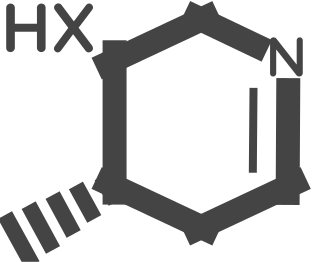 Structure

 P&D probe-likeness score

Structure formats
[[ format ]]
[[ compound[format === 'MOL' ? 'molblock' : format.toLowerCase()] ]]
Description
(extracted from source data)
PHARMACODYNAMICS
DHEA is naturally produced from cholesterol through two cytochrome P450 enzymes. Cholesterol is converted to pregnenolone by the enzyme P450 scc (side chain cleavage); then another enzyme, CYP17A1, converts pregnenolone to 17α-Hydroxypregnenolone and then to DHEA. DHEA is increased by exercise and calorie restriction. Some theorize that the increase in endogenous DHEA brought about by calorie restriction is partially responsible for the longer life expectancy known to be associated with calorie restriction.
MOA
DHEA can be understood as a prohormone for the sex steroids. DHEAS may be viewed as buffer and reservoir. As most DHEA is produced by the zona reticularis of the adrenal cortex, it is argued that there is a role in the immune and stress response. DHEAS/DHEA are useful to detect excess adrenal activity as seen in adrenal cancer or hyperplasia, including certain forms of congenital adrenal hyperplasia as it is produced nearly entirely by the adrenal glands. Women with polycystic ovary syndrome tend to have elevated levels of DHEAS.
INDICATION
DHEA is taken as a supplement for a variety of unsubstantiated indications. The following indications have shown promise and are backed up by some scientific evidence: schizophrenia (DHEA may be more effective in women than men); improving the appearance of older peopleâs skin (taking DHEA by mouth seems to increase skin thickness and moisture, and decrease facial âage spotsâ in elderly men and women); improving ability to achieve an erection in men with sexual dysfunction. Additionally, DHEA has shown promise in improving symptoms of lupus (SLE). Taking DHEA by mouth along with conventional treatment may help reduce the number of times symptoms flare up and may allow a reduction in the dose of prescription drugs needed. DHEA may also help SLE symptoms such as muscle ache and mouth ulcers. DHEA also seems to strengthen bones in SLE patients being treated with high-dose steroids (corticosteroids).; DHEA also shows promise in the treatment of osteoporosis. Taking DHEA by mouth daily seems to improve bone mineral density (BMD) in older women and men with osteoporosis or osteopenia (pre-osteoporosis). DHEA may also increase BMD in young women with the eating disorder called anorexia nervosa. DHEA is often prescribed in India for the induction of ovulation to improve chances of pregnancy.
DESCRIPTION
DHEA (Prasterone) is one of the most abundant steroid hormones. DHEA (Prasterone) mediates its action via multiple signaling pathways involving specific membrane receptors and via transformation into androgen and estrogen derivatives (e.g., androgens, estrogens, 7¦Á and 7¦Â DHEA, and 7¦Á and 7¦Â epiandrosterone derivatives) acting through their specific receptors.
DESCRIPTION
Dehydroepiandrosterone (DHEA; prasterone) is a precursor that is converted to oestrogens and androgens.
(GtoPdb)
[[ p.pathway_name ]]
[[ compound.targets[tid].gene_name ]]

Cell lines
5

Organisms
1
Compound Sets
23
AdooQ Bioactive Compound Library
Axon Medchem Screening Library
Cayman Chemical Bioactives
ChEMBL Approved Drugs
ChEMBL Drugs
CZ-OPENSCREEN Bioactive Library
Drug Repurposing Hub
DrugBank
DrugBank Approved Drugs
DrugCentral
DrugCentral Approved Drugs
DrugMAP
DrugMAP Approved Drugs
Guide to Pharmacology
LSP-MoA library (Laboratory of Systems Pharmacology)
MedChem Express Bioactive Compound Library
Natural product-based probes and drugs
NCATS Inxight Approved Drugs
NIH Clinical Collections (NCC)
Novartis Chemogenetic Library (NIBR MoA Box)
NPC Screening Collection
NURSA ligand set
Probe Miner (suitable probes)
[[ a.name ]]
[[ ligand_id ]]
free of charge
External IDs
71

Molecular Weight
288.21
Hydrogen Bond Acceptors
2
Hydrogen Bond Donors
1
Rotatable Bonds
0
Ring Count
4
Aromatic Ring Count
0
cLogP
3.88
TPSA
37.3
Fraction CSP3
0.84
Chiral centers
6.0
Largest ring
6.0
QED
0.69

Structural alerts
0
No structural alerts detected

Related compounds
Custom attributes
(extracted from source data)
Member status
virtual
MOA
HSD11B1 Expression Inhibitors
protein synthesis stimulant
Indication
menopause
Target
ESR1, ESR2, G6PD, GABRA1, GABRA2, GABRA3, GABRA4, GABRA5, GABRA6, GABRB1, GABRB2, GABRB3, GABRD, GABRE, GABRG1, GABRG2, GABRG3, GABRP, GABRQ, GRIN1, GRIN2A, GRIN2B, GRIN2C, GRIN2D, GRIN3A, GRIN3B, HSD17B1, NR1I2, NR1I3, PPARA, SIGMAR1, SULT2A1, SULT2B1
Steroid precursor
Androgen Receptor
Endogenous Metabolite
Biosynthetic Origin
Terpenoid (Steroid)
Therapeutic Indication
Dyspareunia
Therapeutic Class
Hormone Therapy
Pathway
Metabolic Enzyme/Protease
Vitamin D Related/Nuclear Receptor
Source data