
General
Preferred name
spironolactone
Synonyms
SC9420 ()
Abbolactone ()
Spironolactone ()
NSC-150399 ()
Espironolactona ()
Spironolactone component of aldactazide ()
Spirospare 25 ()
Spiroctan 100 ()
Verospirone ()
Carospir ()
Spiroctan 50 ()
Spironolactone component of cardalis ()
SC-9420 ()
Spirospare 100 ()
Spironolactone ceva ()
Spiroctan 25 ()
Spironolactonum ()
Aldactone ()
Qaialdo ()
Diatensec ()
Spiretic ()
Laractone ()
Gx Spironol ()
Spironolactone-d3 ()
P&D ID
PD002860
CAS
52-01-7
496916-40-6
Tags
available
drug
Approved by
EMA
FDA
First approval
1960
Drug indication
Chronic kidney disease
Congestive heart failure
Drug Status
vet_approved
approved
Max Phase
4.0

Probe control
Probe control not defined

Orthogonal probes
0
No orthogonal probes found

Similar probes
0
No structurally similar probes found
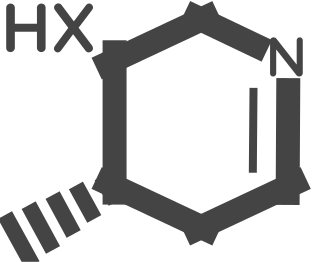 Structure

 P&D probe-likeness score

Structure formats
[[ format ]]
[[ compound[format === 'MOL' ? 'molblock' : format.toLowerCase()] ]]
Description
(extracted from source data)
DESCRIPTION
Spironolactone is a potassium-sparing diuretic, which works by antagonising the effects of aldosterone.
PHARMACODYNAMICS
Originally spironolactone was only studied for its potassium sparing diuretic effect.[A11837] Spironolactone competitively inhibits mineralocorticoid receptors in the distal convoluted tubule to promote sodium and water excretion and potassium retention.[A11837]. Inhibition of this receptor leads to increased renin and aldosterone levels.[A11837]; ; Spironolactone is structurally similar to progesterone and as a result is associated with progestogenic and antiandrogenic effects.[A11837]
MOA
Spironolactone competitively inhibits aldosterone dependant sodium potassium exchange channels in the distal convoluted tubule.[Label] This action leads to increased sodium and water excretion, but more potassium retention.[Label] The increased excretion of water leads to diuretic and also antihypertensive effects.[Label]
ROE
Metabolites of spironolactone are excreted 42-56% in urine, and 14.2-14.6% in the feces.[A178165] No unmetabolized spironolactone is present in the urine.[A178165]
TOXICITY
Patients experiencing an overdose may present with drowsiness, mental confusion, maculopapular or erythematous rash, nausea, vomiting, dizziness, or diarrhea. Vomiting is generally induced or a gastric lavage is performed.[Label] Supportive treatment involves maintining hydration, electrolyte balance, and vital functions[Label].; ; The oral LD50 in mice, rats, and rabbits is >1g/kg.[Label]; ; Spironolactone should be avoided in pregnancy due to reports of feminization of male fetuses in animal studies.[Label] Active metabolites of spironolactone are present in breast milk and levels that are likely inconsequential, though the long term effects have not been studied.[Label]; ; In animal studies, spironolactone slowed follicle development, ovulation, and implantation.[Label] Spironolactone increased the incidence of benign adenomas in the testes of male rats, benign uterine endometrial stromal polyps in female rats, and thyroid follicular cell adenomas in both sexes of rats.[Label] Spironolactone and canrenone are generally not considered to be mutagenic in tests but canrenone occasionally tests positive for mutagenicity with metabolic activation and spironolactone has occasionally tested inconclusive though slightly positive for mutagenicity.[Label]
METABOLISM
Spironolactone is deacetylated to 7α-thiospironolactone.[A178069,A178072] 7α-thiospironolactone is S-methylated to 7α-thiomethylspironolactone or undergoes an elimination reaction to canrenone.[A178069,A178072] 7α-thiomethylspironolactone is reduced to 3α-hydroxythiomethylspironolactone or 3β-hydroxythiomethylspironolactone.[A178069,A178072]; ; Canrenone was originally thought to be the primary circulating metabolite, however more recent studies have demonstrated that the primary metabolite is actually 7α-thiomethylspironolactone.[A11837,A178207]
ABSORPTION
Spironolactone reaches a maximum concentration in 2.6 hours and an active metabolite (canrenone) reaches a maximum concentration in 4.3 hours.[Label] When taken with food, the bioavailability of spironolactone increases to 95.4%.[Label]; ; Giving spironolactone with food increases the maximum concentration from 209ng/mL to 301ng/mL.[A178165] The time to maximum concentration also increases from 2.28 hours to 3.05 hours.[A178165] The area under the curve varies from 2103ng/mL\*hr to 4544ng/mL*hr.[A178165]
HALF-LIFE
1.4 hours.[Label,A178192]; ; Canrenone has a half life of 16.5 hours, 7-α-thiomethylspirolactone has a half life of 13.8 hours, and 6-Ã-hydroxy-7-α-thiomethylspirolactone has a half life of 15 hours.[Label,A178192]
DESCRIPTION
Spironolactone is an orally active, potassium-sparing diuretic, which works by antagonising the effects of aldosterone at renal mineralocorticoid receptors.
(GtoPdb)
INDICATION
Spironolactone is indicated for the treatment of New York Heart Association Class III-IV heart failure, management of edema in cirrhotic adults not responsive to fluid and sodium restrictions, primary hyperaldosteronism short-term preoperatively, primary hyperaldosteronism long-term in patients with aldosterone producing adrenal adenomas that are not candidates for surgery or patients with bilarteral micro/macronodular adrenal hyperplasia, as an add-on therapy in hypertension, and in nephrotic syndrome when treatment of the disease as well as fluid and sodium restriction with other diuretics is inadequate.[Label]; ; Spironolactone has antiandrogenic activity which leads to many of its off label uses. Spironolactone is used off label in the treatment of hirsutism, female pattern hair loss, and adult acne vulgaris.[A178135]; ; Spironolactone is also frequently used for its antiandrogenic effects in transgender female patients due to its low cost and reducing male-pattern hair growth.[A178138]
PRICE
29
DESCRIPTION
Spironolactone is an aldosterone antagonist that acts on the aldosterone mineralocorticoid receptor (IC50=24 nM) and androgen receptor (IC50=77 nM), promotes podocyte autophagy and regulates pain. Spironolactone improves hypertension-related vascular hypertrophy and remodeling by reducing angiotensin II (Ang II)-induced inflammation, reduces aldosterone-induced vascular and soft tissue calcification through PIT1-dependent signaling, and alleviates vascular dysfunction in type II diabetic mice by reducing oxidative stress and restoring NO/GC signaling; at low concentrations, it and its metabolites can interfere with aldosterone biosynthesis in the adrenal cortex and inhibit voltage-dependent Ca2+ channels to exert antihypertensive effects[1][2][3][4][5][6][7][8][9][10].
DESCRIPTION
Pregnane X receptor agonist
(Tocris Bioactive Compound Library)
DESCRIPTION
Mineralocorticoid receptor antagonist
(Tocriscreen Plus)
DESCRIPTION
Spironolactone is a potassium sparing diuretic like eplerenone that competitively inhibits mineralocorticoid receptors in the distal convoluted tubule to promote sodium and water excretion and potassium retention. It is indicated to treat a number of conditions including heart failure, deem, hyperaldosteronism, adrenal hyperplasia, hypertension, and nephrotic syndrome.
(Enamine Bioactive Compounds)
DESCRIPTION
Spironolactone (SC9420) is an Aldosterone Antagonist. The mechanism of action of spironolactone is as an Aldosterone Antagonist.
(TargetMol Bioactive Compound Library)
[[ p.pathway_name ]]
[[ compound.targets[tid].gene_name ]]

Cell lines
0

Organisms
1

Compound Sets
29
CeMM library of unique drugs (CLOUD)
ChEMBL Approved Drugs
ChEMBL Drugs
CZ-OPENSCREEN Bioactive Library
Drug Repurposing Hub
DrugBank
DrugBank Approved Drugs
DrugCentral
DrugCentral Approved Drugs
DrugMAP
DrugMAP Approved Drugs
Enamine Bioactive Compounds
Enamine BioReference Compounds
Guide to Pharmacology
LSP-MoA library (Laboratory of Systems Pharmacology)
MedChem Express Bioactive Compound Library
NCATS Inxight Approved Drugs
NIH Clinical Collections (NCC)
NPC Screening Collection
NURSA ligand set
Other bioactive compounds
Prestwick Chemical Library
ReFrame library
Selleckchem Bioactive Compound Library
TargetMol Bioactive Compound Library
Tocris Bioactive Compound Library
Tocriscreen Plus
ZINC Tool Compounds
[[ a.name ]]
[[ ligand_id ]]
free of charge
External IDs
48

Molecular Weight
416.2
Hydrogen Bond Acceptors
5
Hydrogen Bond Donors
0
Rotatable Bonds
1
Ring Count
5
Aromatic Ring Count
0
cLogP
4.85
TPSA
60.44
Fraction CSP3
0.79
Chiral centers
7.0
Largest ring
6.0
QED
0.57

Structural alerts
0
No structural alerts detected

Related compounds
Custom attributes
(extracted from source data)
Target Type
Nuclear Receptors
MOA
Mineralocorticoid Receptor Antagonist
Antagonist
Target
Mineralocorticoid Receptor
AR, CACNA1A, CACNA1B, CACNA1C, CACNA1D, CACNA1F, CACNA1G, CACNA1H, CACNA1I, CACNA1S, CACNA2D1, CACNA2D2, CACNA2D3, CACNB1, CACNB2, CACNB3, CACNB4, CACNG1, CYP11B2, NR3C1, NR3C2, PGR, SHBG
Androgen Receptor
Calcium Channel
Pathway
Autophagy
Endocrinology/Hormones
Membrane Transporter/Ion Channel
Metabolic Enzyme/Protease
Neuronal Signaling
Vitamin D Related/Nuclear Receptor
Primary Target
Mineralocorticoid Receptors
Disease Area
endocrinology, cardiology, gastroenterology, rheumatology
Indication
hyperaldosteronism, congestive heart failure, hepatic cirrhosis, nephrotic syndrome, hypertension, hypokalemia
Therapeutic Class
Diuretics
Source data