
General
Preferred name
CHLORTHALIDONE
Synonyms
CLODRONIC ACID ()
chlortalidone ()
Chlorthalidone component of regroton ()
NSC-69200 ()
Clortalidona ()
Chlorthalidone component of combipres ()
Chlortalidonum ()
Phthalamudine ()
Chlorthalidone component of clorpres ()
Chlorthalidone component of edarbyclor ()
Hygroton ()
Chlorthalidone component of lopressidone ()
Chlorthalidone component of kerledex ()
Chlorthalidone component of demi-regroton ()
Chlorthalidone component of tenoretic ()
G-33182 ()
Natriuran ()
Thalitone ()
P&D ID
PD002421
CAS
77-36-1
74658-80-3
Tags
available
drug
Approved by
FDA
First approval
1960
Drug indication
Edema
Hypertension
Drug Status
approved
Max Phase
4.0

Probe control
Probe control not defined

Orthogonal probes
0
No orthogonal probes found

Similar probes
0
No structurally similar probes found
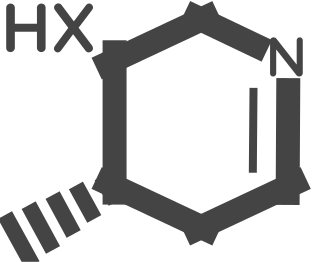 Structure

 P&D probe-likeness score

Structure formats
[[ format ]]
[[ compound[format === 'MOL' ? 'molblock' : format.toLowerCase()] ]]
Description
(extracted from source data)
ROE
Approximately 50% of the administered dose is excreted unmetabolized through the kidney, and excretion is characterized by biphasic elimination with a rapid phase followed by a slow secretory phase[A176327].
MOA
Chlorthalidone prevents reabsorption of sodium and chloride through inhibition of the Na+/Cl- symporter in the corticol diluting segment of the ascending limb of the loop of Henle[A16730]. Reduction of sodium reabsorption subsequently reduces extracellular fluid and plasma volume via an osmotic, sodium-driven diuresis. By increasing the delivery of sodium to the distal renal tubule, Chlorthalidone indirectly increases potassium excretion via the sodium-potassium exchange mechanism. The exact mechanism of chlorthalidone's anti-hypertensive effect is under debate, however, it is thought that increased diuresis results in decreased plasma and extracellular fluid volume which therefore requires decreased cardiac output and overall lowers blood pressure[A176324]. Chlorthalidone has also been shown to decrease platelet aggregation and vascular permeability, as well as promote angiogenesis in vitro, which is thought to be partly the result of reductions in carbonic anhydraseâdependent pathways. These pathways may play a role in chlorthalidone's cardiovascular risk reduction effects[A176330].
INDICATION
Chlorthalidone is indicated in the management of hypertension either as the sole therapeutic agent or to enhance the effect of other antihypertensive drugs in the more severe forms of hypertension. Chlorthalidone is indicated as adjunctive therapy in edema associated with congestive heart failure, hepatic cirrhosis, and corticosteroid and estrogen therapy. Chlorthalidone has also been found useful in edema due to various forms of renal dysfunction, such as nephrotic syndrome, acute glomerulonephritis, and chronic renal failure.
HALF-LIFE
40-50 hours [FDA Label, A176327].
INDICATION
Chlorthalidone is indicated in the management of hypertension either as the sole therapeutic agent or to enhance the effect of other antihypertensive drugs in the more severe forms of hypertension.; ; Chlorthalidone is indicated as adjunctive therapy in edema associated with congestive heart failure, hepatic cirrhosis, and corticosteroid and estrogen therapy.; ; Chlorthalidone has also been found useful in edema due to various forms of renal dysfunction, such as nephrotic syndrome, acute glomerulonephritis, and chronic renal failure.
DESCRIPTION
Chlorthalidone is a thiazide-like diuretic used to treat hypertension.
DESCRIPTION
Chlorthalidone is a thiazide-like diuretic. It has a longer duration of action than other thiazide drugs.
(GtoPdb)
DESCRIPTION
Chlorthalidone is a thiazide-like diuretic used for the treatment of hypertension and for management of edema caused by conditions such as heart failure or renal impairment. Chlorthalidone improves blood pressure and swelling by preventing water absorption from the kidneys through inhibition of the Na+/Cl− symporter in the distal convoluted tubule cells in the kidney. The exact mechanism of chlorthalidone's anti-hypertensive effect is under debate, however, it is thought that increased diuresis results in decreased plasma and extracellular fluid volume, decreased cardiac output and therefore overall reduction in blood pressure.
(Enamine Bioactive Compounds)
[[ p.pathway_name ]]
[[ compound.targets[tid].gene_name ]]
Compound Sets
27
Cayman Chemical Bioactives
ChEMBL Approved Drugs
ChEMBL Drugs
Concise Guide to Pharmacology 2017/18
Concise Guide to Pharmacology 2019/20
Concise Guide to Pharmacology 2021/22
CZ-OPENSCREEN Bioactive Library
DrugBank
DrugBank Approved Drugs
DrugCentral
DrugCentral Approved Drugs
DrugMAP
DrugMAP Approved Drugs
DrugMatrix
Enamine Bioactive Compounds
Guide to Pharmacology
LSP-MoA library (Laboratory of Systems Pharmacology)
Mcule NIBR MoA Box Subset
MedChem Express Bioactive Compound Library
NCATS Inxight Approved Drugs
NIH Clinical Collections (NCC)
Novartis Chemogenetic Library (NIBR MoA Box)
NPC Screening Collection
Prestwick Chemical Library
ReFrame library
Selleckchem Bioactive Compound Library
The Spectrum Collection
[[ a.name ]]
[[ ligand_id ]]
free of charge
External IDs
36

Molecular Weight
338.01
Hydrogen Bond Acceptors
4
Hydrogen Bond Donors
3
Rotatable Bonds
2
Ring Count
3
Aromatic Ring Count
2
cLogP
0.92
TPSA
109.49
Fraction CSP3
0.07
Chiral centers
1.0
Largest ring
6.0
QED
0.76

Structural alerts
0
No structural alerts detected

Related compounds
Custom attributes
(extracted from source data)
Member status
virtual
MOA
Carbonic Anhydrase Type VII Inhibitors
Target
NKCC
Sodium Channel
Therapeutic Class
Antihypertensive Agents
Pathway
Membrane Transporter/Ion Channel
Source data