
General
Preferred name
ISONIAZID
Synonyms
PASINIAZID ()
Isoniazid54-85-3 ()
pyridine-4-carbohydrazide ()
INH ()
Isonicotinic acid hydrazide ()
Isonicotinic hydrazide ()
Hyzyd ()
Dianicotyl ()
Isoniazide ()
Armazide ()
Nicotibine ()
Stanozide ()
Isoniazidum ()
Cedin ()
Nydrazid ()
Ipcazide ()
Laniazid ()
Atcotibine ()
Tisiodrazida ()
Isoniazid component of rifater ()
Dow-Isoniazid ()
Mybasan ()
Iscotin ()
Hidrasonil ()
Hydrazid ()
Isoniazid component of rifamate ()
Isobicina ()
Ertuban ()
Rimifon ()
Isidrina ()
NSC-9659 ()
Eralon ()
Isonicotan ()
Teebaconin ()
Neumandin ()
Cotinazin ()
Isoniazida ()
Armazid ()
P&D ID
PD001926
CAS
54-85-3
37271-10-6
Tags
available
drug
Approved by
FDA
First approval
1952
Drug indication
Pulmonary tuberculosis
Tuberculosis
Drug Status
approved
investigational
Max Phase
4.0

Probe control
Probe control not defined

Orthogonal probes
0
No orthogonal probes found

Similar probes
0
No structurally similar probes found
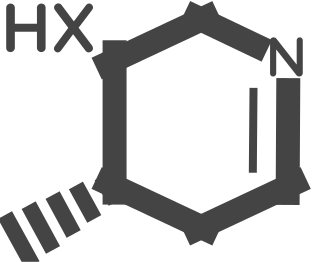 Structure

 P&D probe-likeness score

Structure formats
[[ format ]]
[[ compound[format === 'MOL' ? 'molblock' : format.toLowerCase()] ]]
Description
(extracted from source data)
DESCRIPTION
Isoniazid is an antimycobacterial drug used in the treatment of tuberculosis (TB) . Functionally, it inhibits the synthesis of mycolic acid, an essential component of the mycobacterial cell wall .
(GtoPdb)
PHARMACODYNAMICS
Isoniazid is a bactericidal agent active against organisms of the genus Mycobacterium, specifically M. tuberculosis, M. bovis and M. kansasii. It is a highly specific agent, ineffective against other microorganisms. Isoniazid is bactericidal when mycobacteria grow rapidly and bacteriostatic when they grow slowly.
DESCRIPTION
Isoniazid (INH) is a proagent and must be activated by a bacterial catalase-peroxidase enzyme KatG. Isoniazid is bactericidal to rapidly dividing mycobacteria and has anti-tuberculostatic activity[1][2][3][4].
PRICE
29
DESCRIPTION
Isoniazid (Isonicotinic hydrazide) is an antibacterial agent used primarily as a tuberculostatic.
DESCRIPTION
Isoniazid is an antibacterial agent used primarily as a tuberculostatic. It remains the treatment of choice for tuberculosis. At therapeutic levels isoniazid is bacteriocidal against actively growing intracellular and extracellular Mycobacterium tuberculosis organisms. Specifically isoniazid inhibits InhA, the enoyl reductase from Mycobacterium tuberculosis, by forming a covalent adduct with the NAD cofactor.
(Enamine Bioactive Compounds)
DESCRIPTION
Inhibition of Mycobacterium tuberculosis dihydrofolate reductase
(TargetMol Bioactive Compound Library)
[[ p.pathway_name ]]
[[ compound.targets[tid].gene_name ]]

Cell lines
3

Organisms
4
Compound Sets
26
Cayman Chemical Bioactives
CeMM library of unique drugs (CLOUD)
ChEMBL Approved Drugs
ChEMBL Drugs
CZ-OPENSCREEN Bioactive Library
Drug Repurposing Hub
DrugBank
DrugBank Approved Drugs
DrugCentral
DrugCentral Approved Drugs
DrugMAP
DrugMAP Approved Drugs
DrugMatrix
Enamine Bioactive Compounds
Enamine BioReference Compounds
Guide to Pharmacology
MedChem Express Bioactive Compound Library
NCATS Inxight Approved Drugs
NIH Clinical Collections (NCC)
NPC Screening Collection
Pandemic Response Box
Prestwick Chemical Library
ReFrame library
Selleckchem Bioactive Compound Library
TargetMol Bioactive Compound Library
The Spectrum Collection
[[ a.name ]]
[[ ligand_id ]]
free of charge
External IDs
242

Molecular Weight
137.06
Hydrogen Bond Acceptors
3
Hydrogen Bond Donors
2
Rotatable Bonds
1
Ring Count
1
Aromatic Ring Count
1
cLogP
-0.31
TPSA
68.01
Fraction CSP3
0.0
Chiral centers
0.0
Largest ring
6.0
QED
0.32

Structural alerts
0
No structural alerts detected

Related compounds
Custom attributes
(extracted from source data)
MOA
bacterial InhA inhibitor
FABI inhibitor
Target
Enoyl-[acyl-carrier-protein] reductase
CYP1A2, CYP2C19, CYP2C8, CYP2E1, CYP3A4
Fatty acid synthase
antibiotic
Bacterial
Mitophagy
Indication
tuberculosis
Therapeutic Class
Antitubercular Agents
Pathway
Anti-infection
Autophagy
Source data