
General
Preferred name
NICERGOLINE
Synonyms
Nicergolinum ()
Nimergoline ()
nicergoline SR, Ethypharm ()
Dilasenil ()
FI-6714 ()
Cergodum ()
Sermion ()
Circo-maren ()
Nicergolina ()
Vasospan ()
Nilogrin ()
Ergotop ()
Nicergolent ()
NSC-150531 ()
Memoq ()
Ergobel ()
Duracebrol ()
P&D ID
PD001880
CAS
27848-84-6
Tags
available
drug
Drug indication
Brain ischaemia
Cardiovascular disease
Senile dementia
Drug Status
approved
investigational
Max Phase
3.0

Probe control
Probe control not defined

Orthogonal probes
0
No orthogonal probes found

Similar probes
0
No structurally similar probes found
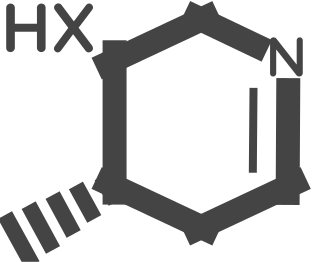 Structure

 P&D probe-likeness score

Structure formats
[[ format ]]
[[ compound[format === 'MOL' ? 'molblock' : format.toLowerCase()] ]]
Description
(extracted from source data)
DESCRIPTION
Nicergoline, an ergoline derivative ester of bromonicotinic acid, is a potent, selective and orally active antagonist of ¦Á1A-adrenoceptor. Nicergoline has vasodilator effects. Nicergoline also has ameliorative effects on cognitive function in mouse models of Alzheimer's disease[1][2].
PRICE
45
DESCRIPTION
Nicergoline (Nicergolinum) is an ergot derivative used to treat senile dementia and other disorders with vascular origins.
(TargetMol Bioactive Compound Library)
[[ p.pathway_name ]]
[[ compound.targets[tid].gene_name ]]

Compound Sets
16
Cayman Chemical Bioactives
ChEMBL Drugs
Drug Repurposing Hub
DrugBank
DrugBank Approved Drugs
DrugCentral
DrugCentral Approved Drugs
DrugMAP
DrugMAP Approved Drugs
LSP-MoA library (Laboratory of Systems Pharmacology)
MedChem Express Bioactive Compound Library
Prestwick Chemical Library
ReFrame library
Selleckchem Bioactive Compound Library
TargetMol Bioactive Compound Library
The Spectrum Collection
[[ a.name ]]
[[ ligand_id ]]
free of charge
External IDs
35

Molecular Weight
483.12
Hydrogen Bond Acceptors
6
Hydrogen Bond Donors
0
Rotatable Bonds
4
Ring Count
5
Aromatic Ring Count
3
cLogP
3.91
TPSA
56.59
Fraction CSP3
0.42
Chiral centers
3.0
Largest ring
6.0
QED
0.53

Structural alerts
0
No structural alerts detected

Related compounds
Custom attributes
(extracted from source data)
Target
Adrenergic Receptor
ADRA1A
Indication
Raynaud's disease, migraine headache, atherosclerosis, thrombosis
Disease Area
rheumatology, neurology/psychiatry, cardiology, hematology
MOA
Adrenergic Receptor antagonist
Pathway
GPCR/G protein
Neuroscience
Neuronal Signaling
Therapeutic Class
Vasodilator Agents
Source data