
General
Preferred name
DAPAGLIFLOZIN
Synonyms
Dapagliflozin Propylene Glycol ()
BMS-512148 ()
BMS-512148 (2S)-1,2-propanediol, hydrate ()
Dapagliflozin propanediol monohydrate ()
Dapagliflozin ((2S)-1,2-propanediol, hydrate)Dapagliflozin propanediol monohydrate ()
Dapagliflozin (BMS512148) ()
Dapagliflozin ((2S)-1,2-propanediol, hydrate) ()
Dapagliflozin (BMS-512148) ()
DAPAGLIFLOZIN PROPANEDIOL ()
Dapagliflozin-d5 ()
Dapagliflozin component of br1019 ()
Dapagliflozin viatris ()
Dapagliflozina ()
LYN-045 ()
Dapagliflozin component of qternmet dapaglifozin ()
Dapagliflozine ()
Dapagliflozin component of qtern ()
Dapagliflozin component of qternmet ()
Dapagliflozin component of qternmet xr ()
Dapagliflozin ()
BMS-512148-05 ()
Dapagliflozin propylene glycolate hydrate ()
Edistride ()
Dapagliflozin propanediol component of xigduo ()
Dapagliflozin compound with (2s)-1,2-propanediol hydrate ()
Farxiga ()
Forxiga ()
Dapagliflozin propanediol ()
DAPAGLIFLOZIN COMPONENT OF BR1019 ()
DAPAGLIFLOZIN COMPONENT OF QTERN ()
DAPAGLIFLOZIN COMPONENT OF QTERNMET ()
DAPAGLIFLOZIN COMPONENT OF QTERNMET DAPAGLIFOZIN ()
DAPAGLIFLOZIN COMPONENT OF QTERNMET XR ()
DAPAGLIFLOZIN VIATRIS ()
DAPAGLIFLOZINA ()
DAPAGLIFLOZINE ()
P&D ID
PD000129
CAS
461432-26-8
960404-48-2
1204219-80-6
Tags
available
drug
Approved by
EMA
PMDA
FDA
First approval
2012
Drug indication
Type-2 diabetes
Heart failure
diabetes mellitus
Drug Status
approved
Max Phase
4.0

Probe control
Probe control not defined

Orthogonal probes
0
No orthogonal probes found

Similar probes
0
No structurally similar probes found
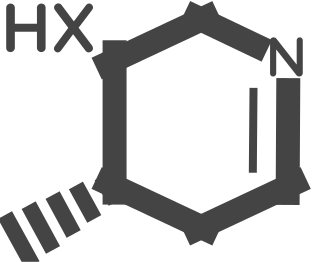 Structure

 P&D probe-likeness score

Structure formats
[[ format ]]
[[ compound[format === 'MOL' ? 'molblock' : format.toLowerCase()] ]]
Description
(extracted from source data)
ROE
75.2% of dapagliflozin is recovered in the urine with 1.6% of the dose unchanged by metabolism[A6757]. 21% of the dose is excreted in the feces with 15% of the dose unchanged by metabolism[Label].
ABSORPTION
Oral dapagliflozin reaches a maximum concentration within 1 hour of administration when patients have been fasting[A6757]. When patients have consumed a high fat meal, the time to maximum concentration increases to 2 hours and the maximum concentration decreases by half though a dose adjustment is not necessary[Label]. Oral dapagliflozin is 78% bioavailable[Label].
PHARMACODYNAMICS
Dapagliflozin inhibits the sodium-glucose contransporter 2(SGLT2) which is primarily located in the proximal tubule of the nephron[A6757]. SGLT2 facilitates 90% of glucose resorption in the kidneys and so its inhibition allows for glucose to be excreted in the urine[A6757]. This excretion allows for better glycemic control and potentially weight loss in patients with type 2 diabetes mellitus[A6757].
INDICATION
Dapagliflozin is indicated to improve glycemic control in adult patients with type 2 diabetes mellitus along with diet and exercise[Label,A6757,A6758].
HALF-LIFE
13.8h[A6757].
TOXICITY
Age, gender, race, and body weight do not affect dapagliflozin dosing requirements[Label,A6758]. Although age does not affect dosing requirements, safety has not been established in pediatric populations and patients at an especially advanced age may be more susceptible to adverse effects[Label]. Animal studies in pregnancy showed no fetal toxicity in the first trimester but exposure later in pregnancy was associated with renal pelvic dilatation and maternal toxicity at much higher doses than the maximum recommended human dose[Label]. Due to this data, dapagliflozin is not recommended in the second and third trimester of pregnancy[Label]. Dapagliflozin is excreted in milk from rats, though this may not necessarily be the case in humans[Label]. Children under 2 years old who are exposed to dapagliflozin may be at risk of improper kidney development[Label]. Dapagliflozin is not recommended in patients with a creatinine clearance below 45mL/min and is contraindicated in patients with creatinine clearance below 30mL/min[Label]. Dose adjustments are not necessary in patients with hepatic impairment at any stage, although the risk and benefit to the patient must be assessed as there is limited data on dapagliflozin use in this population[Label].
METABOLISM
Dapagliflozin is primarily glucuronidated to become the inactive 3-O-glucuronide metabolite(60.7%)[Label,A6757,A6758]. Dapagliflozin also produces another minor glucuronidated metabolite(5.4%), a de-ethylated metabolite(<5%), and a hydroxylated metabolite(<5%)[A6757]. Metabolism of dapagliflozin is mediated by cytochrome p-450(CYP)1A1, CYP1A2, CYP2A6, CYP2C9, CYP2D6, CYP3A4, uridine diphosphate glucuronyltransferase(UGT)1A9, UGT2B4, and UGT2B7[A6758]. Glucuronidation to the major metabolite is mediated by UGT1A9[Label,A6758].
DESCRIPTION
Dapagliflozin is a derivative of naturally occurring dihydrocholine glucoside. It acts as a sodium-glucose cotransporter 2 (SGLT-2) inhibitor. In addition to clinical efficacy in type 2 diabetes, evidence from clinical trial suggests that dapagliflozin is of benefit in treating heart failure with or without type 2 diabetes as a comorbidity .
SARS-CoV-2 and COVID-19: Based on the cardio- and renoprotective benefits of dapagliflozin in T2DM patients, it was evaluated vs. placebo in 1250 hospitalised COVID-19 patients (NCT04350593) , to determine if it would provide similar protection from organ damage caused by SARS-CoV-2 infection. The drug treatment effected a non-significant reduction in the risk of organ failure or death . Subsequent to this finding, another approved SGLT2 inhibitor was added to the RECOVERY trial. (GtoPdb)
SARS-CoV-2 and COVID-19: Based on the cardio- and renoprotective benefits of dapagliflozin in T2DM patients, it was evaluated vs. placebo in 1250 hospitalised COVID-19 patients (NCT04350593) , to determine if it would provide similar protection from organ damage caused by SARS-CoV-2 infection. The drug treatment effected a non-significant reduction in the risk of organ failure or death . Subsequent to this finding, another approved SGLT2 inhibitor was added to the RECOVERY trial. (GtoPdb)
DESCRIPTION
Dapagliflozin (BMS-512148), a new type of agent used to treat diabetes mellitus (DM), is a competitive sodium/glucose cotransporter 2 (SGLT2) inhibitor, which results in excretion of glucose into the urine[1]. Dapagliflozin induces HIF1 expression and attenuates renal IR injury[2].
PRICE
52
DESCRIPTION
Dapagliflozin ((2S)-1,2-propanediol, hydrate) is the S-enantiomer of Dapagliflozin 1,2-propanediol, hydrate. Dapagliflozin ((2S)-1,2-propanediol, hydrate), a new type of agent used to treat diabetes mellitus (DM), is a competitive sodium/glucose cotransporter 2 (SGLT2) inhibitor, which results in excretion of glucose into the urine[1]. Dapagliflozin ((2S)-1,2-propanediol, hydrate) induces HIF1 expression and attenuates renal IR injury[2].
PRICE
37
DESCRIPTION
Dapagliflozin is a sodium-glucose cotransporter (SGLT) inhibitor. It is used in the management of type 2 diabetes mellitus.
(Enamine Bioactive Compounds)
DESCRIPTION
Dapagliflozin (BMS-512148) is a selective sodium-glucose co-transporter subtype 2 (SGLT2) inhibitor with antihyperglycemic activity.
(TargetMol Bioactive Compound Library)
DESCRIPTION
Dapagliflozin ((2S)-1,2-propanediol, hydrate) (BMS-512148 (2S)-1,2-propanediol, hydrate) is a selective, orally active inhibitor of the renal sodium-glucose co-transporter type 2 (SGLT2), in development for treating type 2 diabetes mellitus (T2DM). It inhibits SGLT2, responsible for at least 90% of glucose reabsorption in the kidney.
(TargetMol Bioactive Compound Library)
[[ p.pathway_name ]]
[[ compound.targets[tid].gene_name ]]

Compound Sets
30
AdooQ Bioactive Compound Library
Axon Medchem Screening Library
ChEMBL Approved Drugs
ChEMBL Drugs
Concise Guide to Pharmacology 2017/18
Concise Guide to Pharmacology 2019/20
Concise Guide to Pharmacology 2021/22
Concise Guide to Pharmacology 2023/24
CZ-OPENSCREEN Bioactive Library
Drug Repurposing Hub
DrugBank
DrugBank Approved Drugs
DrugCentral
DrugCentral Approved Drugs
DrugMAP
DrugMAP Approved Drugs
Enamine Bioactive Compounds
EU-OPENSCREEN Bioactive Compound Library
EUbOPEN Chemogenomics Library
Guide to Pharmacology
LSP-MoA library (Laboratory of Systems Pharmacology)
Mcule NIBR MoA Box Subset
NCATS Inxight Approved Drugs
Novartis Chemogenetic Library (NIBR MoA Box)
ReFrame library
Selleckchem Bioactive Compound Library
The Spectrum Collection
[[ a.name ]]
[[ ligand_id ]]
free of charge
External IDs
59

Molecular Weight
408.13
Hydrogen Bond Acceptors
6
Hydrogen Bond Donors
4
Rotatable Bonds
6
Ring Count
3
Aromatic Ring Count
2
cLogP
1.84
TPSA
99.38
Fraction CSP3
0.43
Chiral centers
5.0
Largest ring
6.0
QED
0.58

Structural alerts
0
No structural alerts detected

Related compounds
Custom attributes
(extracted from source data)
Target
hSGLT2
SGLT
HIF1
SGLT2
SLC5A1, SLC5A2
SGLT2 inhibitor
Member status
member
MOA
SGLT-2 Inhibitors
sodium/glucose cotransporter inhibitor
Indication
diabetes mellitus
Pathway
Membrane Transporter/Ion Channel
Angiogenesis
Chromatin/Epigenetic
GPCR/G protein
Recommended Cell Concentration
None
Source data